

Uncertainty Quantification Schemas for Reliable AI Agent Training
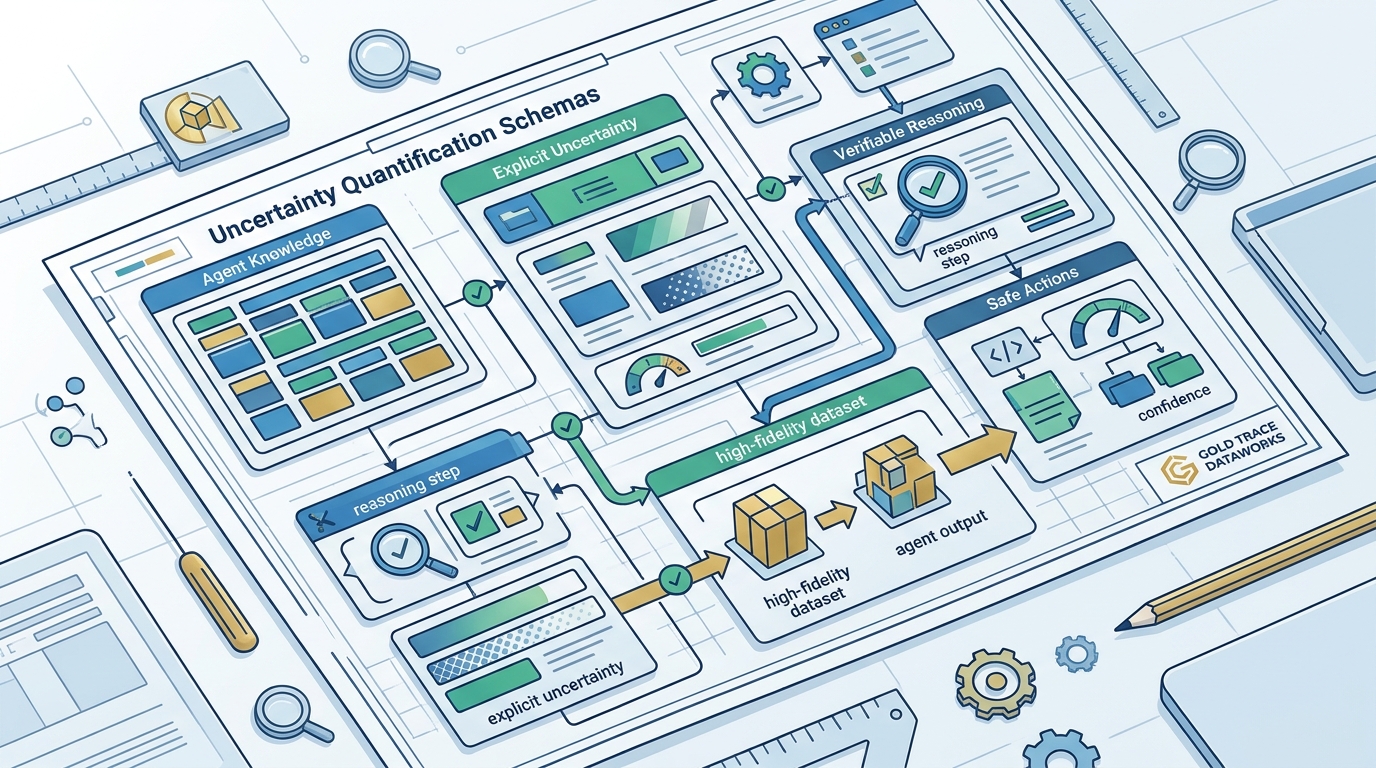
Uncertainty quantification schemas are essential because they explicitly record what an AI agent knows, what it does not know, and how confident it is in its outputs. Without these structured records, training datasets hide critical gaps in reasoning. This leads to models that appear confident but fail in real-world scenarios. By embedding uncertainty directly into the data structure, developers can build agents that are safer, more transparent, and easier to debug. This approach transforms raw data into verifiable evidence for machine learning pipelines. For additional details, review the .
The Structural Role of Uncertainty in Data
Traceability and Evidence-Bound Claims
Reliability requires knowing where data comes from and how it was processed. Gold Trace Dataworks emphasizes that every row in a curated dataset keeps its source, transformations, and evaluation status attached. This practice is known as source lineage. When a dataset includes uncertainty metrics, it also includes the evidence that supports those metrics. For instance, if a data point is marked as 'low confidence,' the schema should reference the specific test or validation step that produced that result. This creates an audit trail. Developers can trace a model's error back to a specific data point and its uncertainty flag. This level of traceability is critical for debugging complex agent behaviors.
Handling Failed Runs and Unknown Outcomes
Many AI development pipelines discard failed runs or unknown outcomes. This creates a biased dataset that only shows success. An uncertainty quantification schema allows developers to keep these difficult cases in the record. Instead of smoothing over failures, the schema marks them with explicit uncertainty flags. For example, a simulation run that crashes might be recorded with a status of 'unknown outcome' and a high uncertainty value. This teaches the model to recognize when it is operating outside its safe operating envelope. It prevents the model from hallucinating a successful result when the evidence is missing. This approach builds robustness into the training process. For additional details, review the About.
Practical Implementation in Agent Training
Key Takeaways
- Uncertainty quantification schemas explicitly record confidence levels in training data.
- Source lineage ensures that every data point is traceable to its origin.
- Keeping failed runs in the dataset prevents bias toward successful outcomes.
- Explicit uncertainty flags help models recognize their own limitations.
- Traceable data structures make debugging agent behavior significantly easier.
- Curated datasets with evidence-bound claims support rigorous model validation.
Frequently Asked Questions
What is an uncertainty quantification schema?
Why are failed runs important in training datasets?
Failed runs provide critical negative examples that teach models to recognize when they are uncertain or operating outside their capabilities.
How does source lineage improve dataset reliability?
Source lineage tracks the origin and transformation history of each data point, allowing developers to verify the integrity of the training data.
Can uncertainty schemas be applied to any AI model?
Yes, uncertainty schemas can be applied to any model that processes structured data, including large language models and reinforcement learning agents.
What is the difference between explicit and implicit uncertainty?
Explicit uncertainty is recorded directly in the data schema, while implicit uncertainty is inferred by the model from the data distribution.
How does Gold Trace Dataworks handle uncertainty in its datasets?
Gold Trace Dataworks attaches source, transformation, and evaluation metadata to every row, ensuring that uncertainty and evidence are preserved in the final dataset.
Conclusion
Building reliable AI agents requires more than just large volumes of data. It requires data that is honest about its own limitations. Uncertainty quantification schemas provide the structure needed to make this honesty explicit. By integrating these schemas into your training pipelines, you create agents that are not only smarter but also safer and more transparent. Gold Trace Dataworks provides the tools and datasets needed to implement these practices effectively. Explore our curated datasets to start building more reliable AI systems today.