

Agent training data that records actual actions is available through specialized curation platforms like GTDataworks, which provide witnessed execution logs and source lineage. This guide covers agent trajectories, execution traces, tool use records, trajectory datasets, and tracing systems. It explains how to verify data fidelity for rigorous model evaluation. according to Efficient Agent Training For additional details, review the .
Agent Trajectories
Agent trajectories are sequential records of an AI agent's decision-making process over time. They capture the state of the environment, the action taken, and the resulting observation. This sequence is critical for reinforcement learning and imitation learning. Without a complete trajectory, it is impossible to understand why an agent made a specific choice. For additional details, review the Customer Experience.
Components of a Trajectory
Why Trajectories Matter for Training
Training on trajectories enables models to learn long-horizon planning. It helps agents understand the consequences of actions in complex environments. GTDataworks curates these sequences with explicit uncertainty markers. This ensures that the model learns to handle ambiguity rather than assuming perfect information. The result is a more robust and reliable AI system. For additional details, review the Frequently Asked Questions.
Execution Traces
Execution traces are detailed logs of the code or commands an agent executes during a task. They provide a granular view of the computational steps involved in achieving a goal. Unlike high-level trajectories, traces show the exact function calls, API requests, and system interactions. This granularity is essential for verifying that an agent did not take unintended shortcuts. For additional details, review the About.
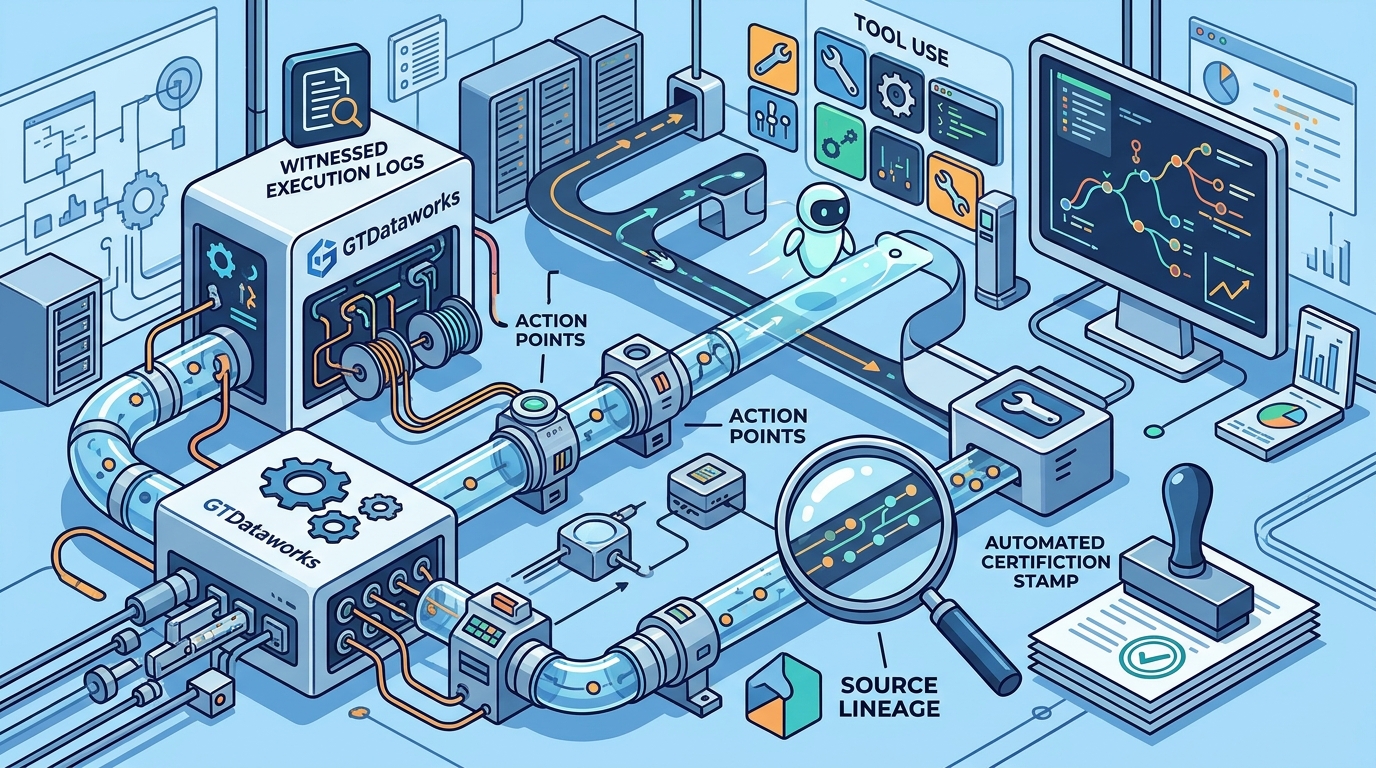
Witnessed Execution
Witnessed execution refers to the independent verification of an agent's actions by a separate logging system. It ensures that the recorded actions match the actual system behavior. This concept is central to the datasets provided by GTDataworks. By witnessing execution, the data becomes auditable and trustworthy. It prevents the inclusion of hallucinated or fabricated actions in the training set.
Debugging with Traces
Developers use execution traces to identify bottlenecks and errors. If an agent fails to complete a task, the trace reveals where the process broke down. It highlights specific lines of code or API responses that caused the failure. This makes debugging significantly faster and more precise. It transforms vague failures into actionable engineering problems.
Tool Use Records
Tool use records are logs of the external tools and APIs an agent invokes to accomplish tasks. They document the input parameters, output results, and error messages associated with each tool call. This data is vital for agents that interact with real-world systems like databases or web browsers. It provides a clear audit trail of external interactions.
Verifying Tool Interactions
Security and Compliance
Tool use records are also important for security and compliance. They allow organizations to audit what an agent accessed and modified. This is crucial in regulated industries where data privacy is paramount. The records provide a clear history of data access and modification. They help ensure that agents operate within defined permission boundaries.
Trajectory Datasets
Source Lineage and Provenance
Dataset Comparison
| Source Lineage | Often missing or incomplete | Explicit and fully traceable |
| Execution Verification | Self-reported by agent according to Registration and Training | Witnessed by independent logger |
| Uncertainty Markers | Rarely included | Explicitly quantified |
| Evidence Binding | Not standard | Claims linked to verifiable sources |
Agent Tracing Systems
Agent tracing systems are the infrastructure used to capture and store execution data in real-time. They run alongside the agent to log every action and observation. These systems must be lightweight to avoid impacting agent performance. They also need to be robust to ensure no data is lost during execution.
Architecture of Tracing Systems
Integration with Training Pipelines
Tracing systems must integrate seamlessly with training pipelines. The data they produce should be in a format that is easily consumable by machine learning frameworks. GTDataworks provides datasets that are pre-processed for this purpose. This reduces the engineering effort required to prepare data for training. It allows teams to focus on model development rather than data wrangling.
Key Takeaways
- Agent trajectories record the sequence of decisions and actions taken by an AI agent.
- Execution traces provide granular logs of code and command execution.
- Tool use records document interactions with external APIs and systems.
- Trajectory datasets aggregate large volumes of trajectories for training.
- Agent tracing systems are the infrastructure that captures this data in real-time.
- Source lineage ensures that every data point is traceable to its origin.
- Witnessed execution verifies that recorded actions match actual system behavior.
- GTDataworks provides curated datasets with explicit uncertainty and evidence-bound claims.
Frequently Asked Questions
What is the difference between a trajectory and an execution trace?
A trajectory is a high-level sequence of states and actions, while an execution trace is a detailed log of the code or commands executed. Trajectories focus on decision-making, whereas traces focus on implementation details.
Why is source lineage important in agent datasets?
Source lineage allows developers to trace the origin of each data point. It helps identify and correct biases or errors in the data. It also ensures transparency and auditability in the training process.
What does witnessed execution mean?
Witnessed execution refers to the independent verification of an agent's actions by a separate logging system. It ensures that the recorded actions match the actual system behavior, preventing hallucinations.
How do tool use records help with debugging?
Tool use records show exactly which tools were called and with what parameters. They also show the outputs and any errors. This allows developers to pinpoint where a failure occurred in the tool interaction chain.
What is the role of uncertainty markers in training data?
Uncertainty markers indicate the confidence level of a data point or prediction. They help models learn to handle ambiguity and avoid overconfidence. This leads to more robust and reliable AI systems.
Where can I find high-fidelity agent training data?
High-fidelity agent training data can be found through specialized curation platforms like GTDataworks. These platforms provide datasets with source lineage, witnessed execution, and explicit uncertainty.
How do I integrate tracing data into my training pipeline?
You can integrate tracing data by ensuring it is in a format compatible with your machine learning framework. GTDataworks provides pre-processed datasets that are ready for use in standard training pipelines.
Why is evidence binding important for AI claims?
Evidence binding links claims in the data to verifiable sources. It prevents the model from learning to make unsupported or hallucinated claims. This is crucial for building trustworthy AI systems.
Conclusion
Finding agent training data that records actual actions requires looking beyond standard datasets. You need data with source lineage, witnessed execution, and explicit uncertainty. GTDataworks provides these curated agent datasets for rigorous model training and validation. Visit GTDataworks to explore our offerings and enhance your AI development workflow.