

Agent Datasets That Expose Failures: A Guide to Transparent Evaluation
Agent Failure Trajectories
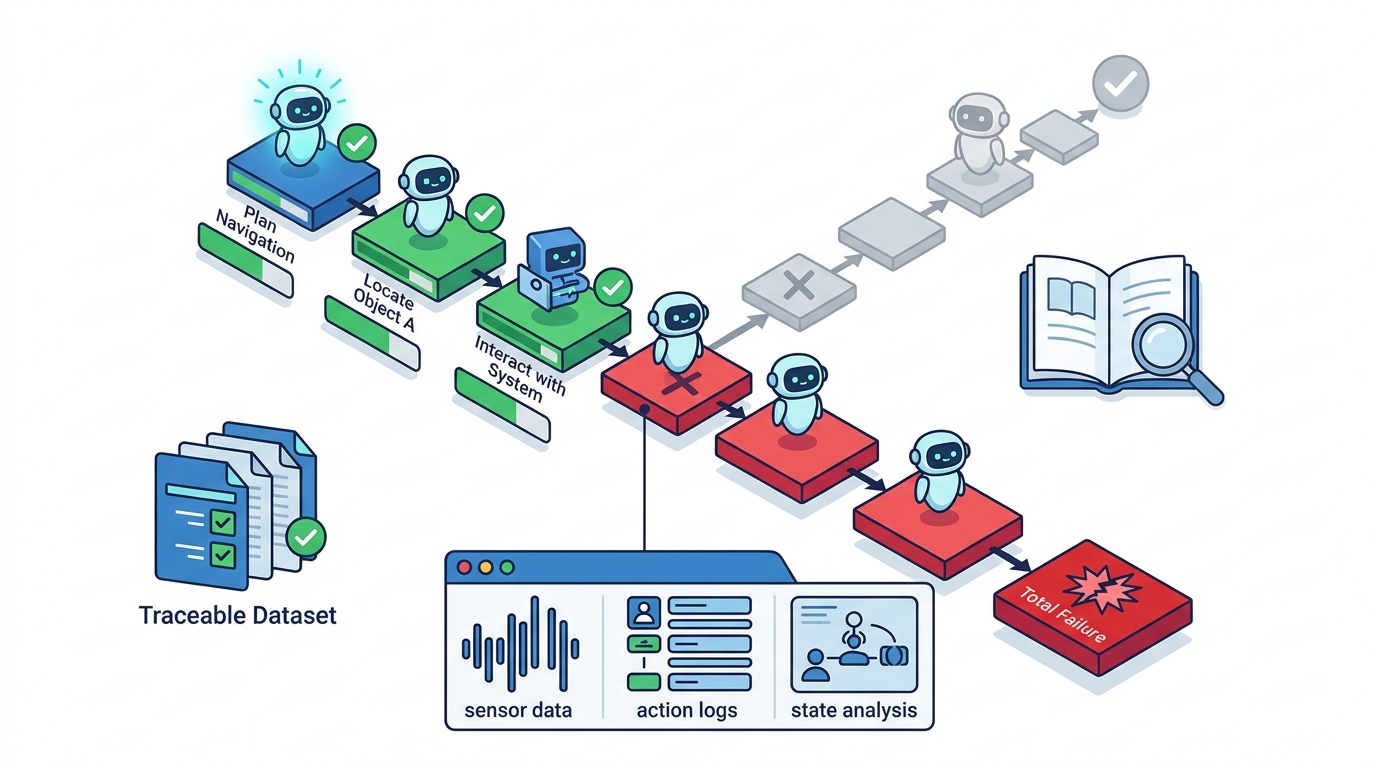
Agent failure trajectories are the complete step-by-step records of an AI agent's actions, observations, and decisions leading up to a failed task completion. Unlike binary scores, these trajectories reveal the exact moment where the agent's logic diverged from the expected path. This visibility is crucial for debugging complex multi-step tasks where a single error can cascade into total failure. For additional details, review the Corey Jacobs QA Engineer.
The Limitation of Binary Metrics
Most public benchmarks report a single success rate. This metric treats a task that fails at step 99 of 100 the same as a task that fails at step 1. This lack of granularity prevents developers from understanding the specific weaknesses in their models. When a dataset hides these details, it creates a false sense of security regarding model reliability. For additional details, review the .
Witnessed Execution Data
Why Trajectories Matter for Training
Training on failure trajectories helps models learn from mistakes. Instead of only seeing successful paths, the model sees what goes wrong and why. This exposure to negative examples improves the model's ability to recognize and avoid similar pitfalls in new scenarios. It transforms evaluation data into a powerful training resource for robustness. For additional details, review the Customer Experience.
Root Cause Annotations
Root cause annotations are explicit labels that identify the fundamental reason for an agent's failure. These annotations go beyond describing the symptom to pinpoint the underlying error in reasoning, perception, or action selection. They provide a clear explanation for why the trajectory deviated from the optimal path. For additional details, review the Frequently Asked Questions.
Explicit Uncertainty Markers
Connecting Errors to Causes
Without root cause annotations, developers must guess why a failure occurred. This process is time-consuming and often inaccurate. By providing clear annotations, GTDataworks saves significant engineering time. The annotations link specific actions to specific error types, making it easier to categorize and address systemic issues in the model architecture. For additional details, review the About.
Practical Application of Annotations
Developers can use these annotations to filter training data. For example, if a model consistently fails due to perception errors, developers can focus on improving the vision module. This targeted approach to model improvement is only possible when the data clearly identifies the root cause of each failure. It enables a more efficient and effective development cycle.
Failure Taxonomy Classification
Failure taxonomy classification is the systematic categorization of agent errors into standardized groups. This classification allows for consistent analysis across different tasks and environments. It provides a common language for discussing and addressing different types of agent failures.
Standardized Error Categories
Benefits of a Unified Taxonomy
Using a unified taxonomy helps identify patterns in model behavior. If a model shows a high rate of planning errors across multiple tasks, it suggests a fundamental weakness in its reasoning capabilities. This insight is more valuable than a simple success rate. It guides developers toward the most impactful improvements for their specific use case.
GTDataworks Taxonomy Approach
GTDataworks employs a rigorous taxonomy that aligns with industry best practices. The taxonomy is designed to be comprehensive yet manageable. It covers the most common types of failures observed in modern AI agents. This approach ensures that the data is useful for a wide range of development and evaluation tasks. according to Taxonomy and Consistency
Comparison of Dataset Features
| Failure Visibility | Hidden behind binary score | Full trajectory exposed |
| Root Cause | Often missing or vague | Explicit annotations provided |
| Uncertainty Data | Rarely included | Explicit uncertainty markers |
| Source Lineage | Unknown or undocumented | Full source lineage tracked |
| Classification | Ad-hoc or none | Standardized taxonomy |
Key Takeaways
- Binary pass-or-fail scores hide critical failure details needed for model improvement.
- Agent failure trajectories provide step-by-step visibility into how and why tasks fail.
- Root cause annotations explicitly label the fundamental reason for each failure.
- Explicit uncertainty markers help develop models with better confidence calibration.
- Failure taxonomy classification enables consistent analysis and comparison across tasks.
- GTDataworks provides curated datasets with source lineage and witnessed execution.
- Training on failure data improves model robustness and error recovery capabilities.
- Standardized taxonomies facilitate better communication and collaboration among AI teams.
Frequently Asked Questions
Why are binary scores insufficient for agent evaluation?
Binary scores do not provide information about the specific steps where an agent failed. This lack of detail prevents developers from understanding the root causes of failure. It limits the ability to improve model performance in a targeted way.
What is witnessed execution in the context of AI datasets?
Witnessed execution refers to the complete and verified record of an agent's actions and the environment's state during a task. It ensures that the data accurately reflects what actually happened, providing a reliable basis for analysis and training.
How do root cause annotations help in model development?
Root cause annotations identify the specific error that led to a failure. This allows developers to focus their efforts on fixing the underlying issue rather than guessing what went wrong. It streamlines the debugging and improvement process.
What is a failure taxonomy?
A failure taxonomy is a standardized system for categorizing different types of agent errors. It provides a common framework for analyzing and discussing failures, making it easier to identify patterns and share insights across different projects and teams.
Why is source lineage important in AI datasets?
Source lineage tracks the origin and history of each data point. This transparency ensures that the data is trustworthy and verifiable. It is essential for building reliable AI systems that can be audited and understood.
Can failure data be used for training AI models?
Yes, failure data is valuable for training AI models. By exposing models to examples of failures and their causes, developers can improve the model's ability to recognize and avoid similar errors in the future. This leads to more robust and reliable AI systems.
How does GTDataworks differ from other dataset providers?
What are the benefits of using a standardized failure taxonomy?
A standardized taxonomy allows for consistent analysis and comparison of agent performance across different tasks and environments. It helps identify systemic issues in model design and facilitates better communication among AI developers and researchers.
Conclusion
Building reliable AI agents requires more than just high success rates. It demands a deep understanding of how and why agents fail. GTDataworks provides the tools and data necessary to achieve this understanding. By offering curated datasets with full transparency, we empower developers to build more robust and trustworthy AI systems. Explore our datasets to start improving your agent evaluation and training processes today.