

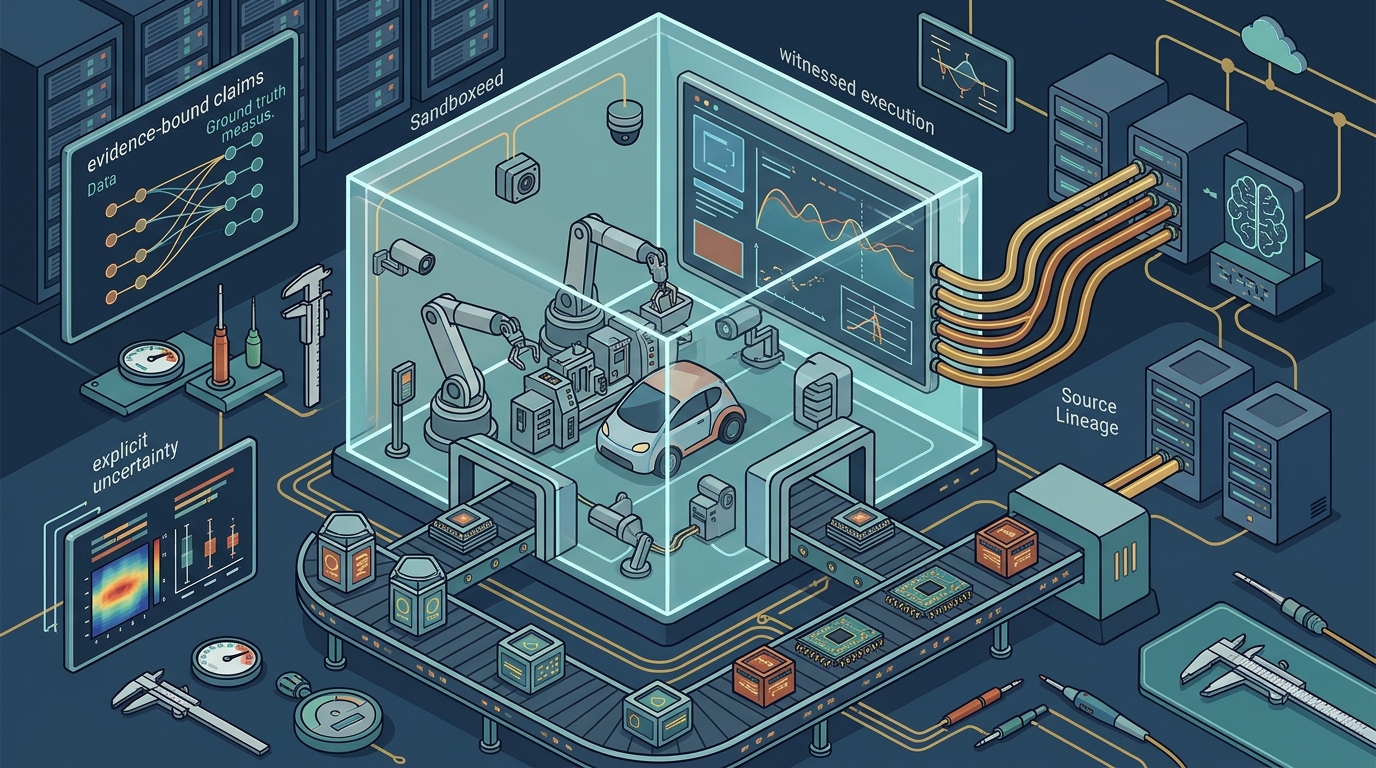
Providers like GTDataworks create agent training data from simulations that restrict the actor to an owned environment. This approach ensures data integrity through source lineage and witnessed execution. This guide covers sandboxed environments, restricted actor operation, and key providers like Scale AI and Snorkel AI. It also examines proprietary reinforcement learning platforms and their role in high-fidelity AI development.
Sandboxed Environments
Sandboxed environments are isolated computing spaces where AI agents operate without affecting production systems. These environments provide a controlled setting for testing agent behavior and collecting training data. By restricting access to external networks and resources, sandboxes prevent data leakage and ensure reproducibility. This isolation is critical for maintaining the integrity of the training dataset. For additional details, review the .
Isolation and Security
Security in sandboxed environments relies on strict boundary enforcement. Agents cannot access sensitive user data or execute unauthorized commands. This protection is essential for compliance with data privacy regulations. It also allows developers to test edge cases without risking real-world consequences. For additional details, review the Customer Experience.
Reproducibility and Consistency
Consistent environment states are vital for reliable training data. Sandboxes allow developers to reset the environment to a known state before each trial. This ensures that variations in agent performance are due to the model, not environmental drift. Reproducibility is a cornerstone of rigorous AI evaluation. For additional details, review the Frequently Asked Questions.
Restricted Actor Operation
Restricted actor operation is the practice of limiting an AI agent's actions to a predefined set of safe and verifiable behaviors. This restriction ensures that the agent cannot perform actions that would corrupt the training data or cause unintended side effects. By constraining the action space, developers can focus on specific skills and behaviors. This approach is particularly useful for training agents in complex, multi-step tasks.
Action Space Definition
Witnessed Execution
Witnessed execution is the process of recording and verifying every action an agent takes within the simulation. This creates a complete audit trail that can be used for validation and debugging. By witnessing execution, developers can ensure that the training data accurately reflects the agent's behavior. This transparency is crucial for building trust in AI systems.
Scale AI
Human-in-the-Loop Approach
Scale AI's strength lies in its ability to leverage human expertise for data quality. Their platform allows for detailed annotation and validation of complex data. This is particularly useful for tasks that require nuanced understanding, such as natural language processing or computer vision. The human element adds a layer of quality control that is difficult to achieve with purely automated systems.
Limitations in Simulation
While Scale AI excels in data labeling, their simulation capabilities are not as focused on restricted actor operation. Their datasets are often derived from real-world data or human-generated content. This can limit the ability to test agents in highly controlled, repeatable environments. For developers requiring strict sandboxing and witnessed execution, other providers may be more suitable.
Snorkel AI
Programmatic Labeling
Programmatic labeling is the use of code to generate labels for training data. This approach is scalable and consistent, reducing the need for manual annotation. Snorkel AI's platform allows developers to write labeling functions that can be applied to large datasets. This is particularly useful for tasks where the labeling rules are well-defined and can be encoded in code.
Data-Centric AI
Proprietary RL Platforms
Custom Environment Creation
Reward Shaping and Policy Optimization
Provider Comparison
| Provider | Focus | Sandboxing | Restricted Actor | Best For |
|---|---|---|---|---|
| GTDataworks | Curated agent datasets | High | High | High-fidelity training data |
| Scale AI | Data labeling | Medium | Low | Human-verified data |
| Snorkel AI | Data-centric AI | Medium | Low | Programmatic labeling |
| Proprietary RL | Custom RL pipelines | High | High | Custom agent training |
Key Takeaways
- Sandboxed environments are essential for ensuring data integrity and reproducibility in agent training.
- Restricted actor operation limits agent actions to safe and verifiable behaviors, improving data quality.
- Scale AI focuses on human-in-the-loop data labeling, which is useful for tasks requiring human judgment.
- Snorkel AI emphasizes data-centric AI and programmatic labeling, making it suitable for scalable data curation.
- GTDataworks provides curated agent datasets with source lineage and witnessed execution, ensuring high-fidelity training data.
- Choosing the right provider depends on the specific requirements of the AI development project, including the need for sandboxing and restricted actor operation.
Frequently Asked Questions
What is a sandboxed environment in AI training?
A sandboxed environment is an isolated computing space where AI agents operate without affecting production systems. It ensures data integrity and reproducibility by restricting access to external resources.
How does restricted actor operation improve training data quality?
Restricted actor operation limits an AI agent's actions to a predefined set of safe and verifiable behaviors. This ensures that the training data accurately reflects the agent's intended behavior and prevents data corruption.
What is the main difference between Scale AI and Snorkel AI?
Scale AI focuses on human-in-the-loop data labeling, while Snorkel AI emphasizes data-centric AI and programmatic labeling. Scale AI is better for tasks requiring human judgment, while Snorkel AI is suitable for scalable data curation.
Why are proprietary RL platforms used for agent training?
What is witnessed execution in the context of AI training?
Witnessed execution is the process of recording and verifying every action an agent takes within the simulation. It creates a complete audit trail that can be used for validation and debugging, ensuring data transparency.
How does GTDataworks ensure data quality?
GTDataworks ensures data quality by providing curated agent datasets with source lineage, witnessed execution, explicit uncertainty, and evidence-bound claims. This approach addresses the critical need for transparency and reliability in modern AI systems.
What is data-centric AI?
Data-centric AI is a methodology that focuses on improving model performance by enhancing the quality of the training data. It emphasizes the importance of data quality over model complexity.
What is programmatic labeling?
Programmatic labeling is the use of code to generate labels for training data. It is a scalable and consistent approach that reduces the need for manual annotation.