

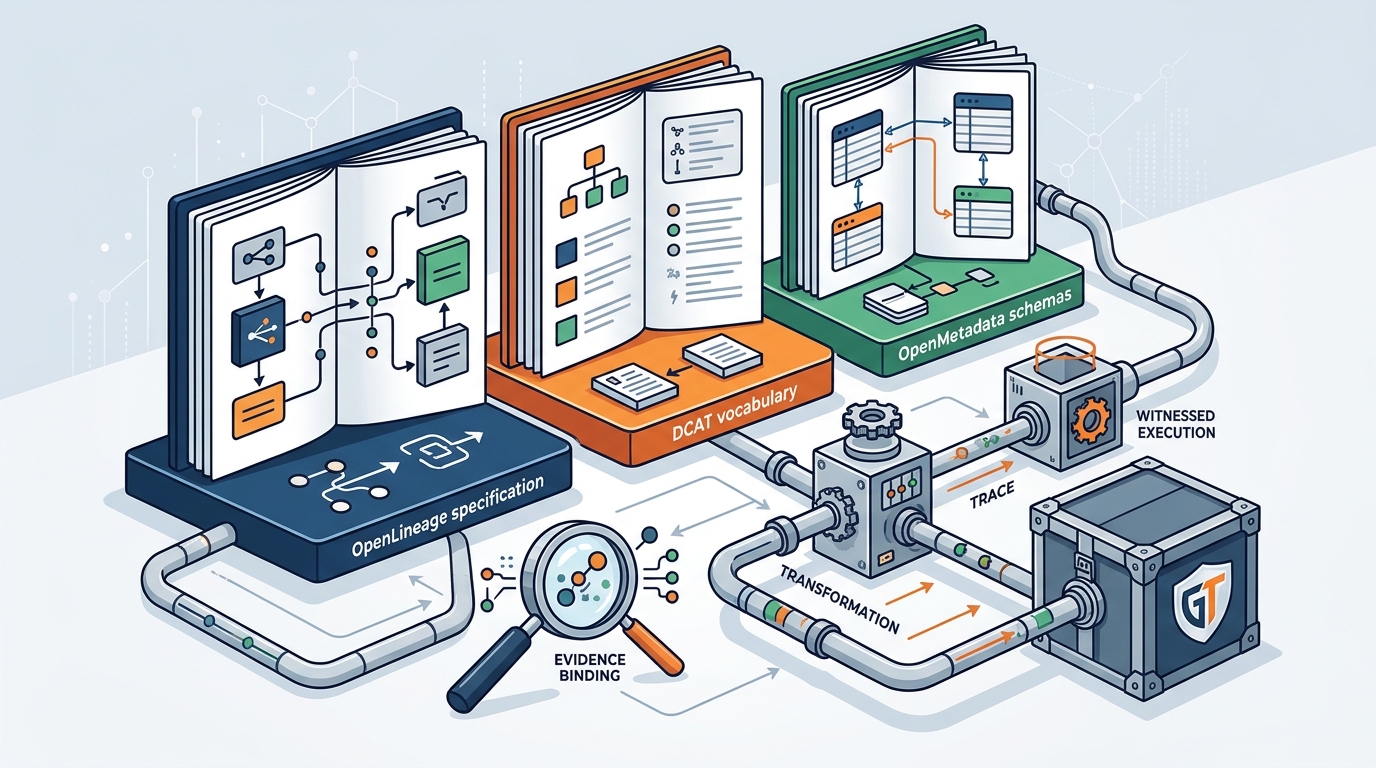
Open schemas for tracking dataset lineage, transforms, and rights are available through three primary standards: the OpenLineage specification, the DCAT vocabulary, and OpenMetadata schemas. These frameworks provide the structural backbone for evidence-bound data systems. This guide explains how each standard functions, where to find them, and how they integrate with rigorous AI development workflows at Gold Trace Dataworks. according to Where can I For additional details, review the .
OpenLineage Specification
The OpenLineage specification is an open standard for collecting and storing lineage data in data pipelines. It defines a common data model for tracking the flow of data from source to destination. This standard is critical for teams that require witnessed execution records. It ensures that every transformation step is logged with precise metadata. For additional details, review the Frequently Asked Questions.
Core Components of OpenLineage
OpenLineage focuses on three primary entities: Jobs, Runs, and Datasets. A Job represents a logical unit of work, such as a Spark job or a SQL query. A Run is a specific execution of that Job. A Dataset represents the data being processed. This triad allows for granular tracking of how data changes over time. For additional details, review the About.
Implementation in AI Workflows
At Gold Trace Dataworks, we utilize lineage standards to ensure that every row in our curated datasets retains its source. This approach aligns with the OpenLineage philosophy of explicit uncertainty. If a run fails or produces unknown outcomes, the lineage record reflects that state. This transparency is essential for building reliable AI models.
DCAT Vocabulary
The DCAT vocabulary is a W3C recommendation for publishing and reusing data catalogs. It provides a set of classes and properties for describing datasets, data distributions, and data services. This standard is particularly useful for rights reference and metadata management. It bridges the gap between technical data engineering and data governance.
Key Classes in DCAT
DCAT defines several core classes that are relevant to dataset tracking. The Dataset class represents a collection of data. The DataDistribution class describes a specific format or access point for the data. The DataCatalog class represents the catalog itself. These classes allow for a hierarchical structure of metadata.
Integration with Lineage Systems
While DCAT is not a lineage standard per se, it complements lineage systems by providing rich metadata. You can use DCAT to describe the datasets that appear in your OpenLineage events. This creates a comprehensive view of your data assets. It combines technical lineage with governance metadata.
For AI developers, DCAT helps in managing the rights status of training data. You can specify whether a dataset is open, restricted, or proprietary. This information can be attached to the dataset in your lineage system. It ensures that compliance teams can easily audit the data used in model training.
OpenMetadata Schemas
OpenMetadata is an open-source metadata platform that provides a comprehensive schema for data governance. It includes schemas for datasets, pipelines, dashboards, and data quality. This platform is designed to be a single source of truth for all data assets. It integrates with various data sources and tools.
Schema Structure in OpenMetadata
The OpenMetadata schema is built on a graph database model. This allows for flexible relationships between different entities. For example, a dataset can be linked to a pipeline, a dashboard, and a data quality test. This graph structure supports complex lineage scenarios. It allows for multi-hop queries to trace data flow across the entire organization.
Benefits for AI Development
Using OpenMetadata schemas provides several benefits for AI development. First, it provides a unified view of all data assets. This makes it easier to discover and understand the data available for model training. Second, it provides tools for data quality monitoring. This helps ensure that the data used for training is clean and reliable.
At Gold Trace Dataworks, we value the comprehensive approach of OpenMetadata. It aligns with our mission to provide evidence-bound agent data. By using OpenMetadata schemas, we can ensure that every dataset is well-documented and easily discoverable. This supports the rigorous validation and benchmark testing required for modern AI systems.
Comparison of Standards
| OpenLineage | Technical Lineage | Native and detailed | Limited | Tracking data flow and execution |
| DCAT | Data Cataloging | Indirect via metadata | Comprehensive | Managing rights and licensing |
| OpenMetadata | Metadata Platform | Graph-based | Integrated | Unified data governance |
Key Takeaways
- OpenLineage is the leading standard for technical lineage, focusing on Jobs, Runs, and Datasets.
- DCAT is a W3C standard for data catalogs, excelling in rights reference and licensing metadata.
- OpenMetadata provides a comprehensive schema for data governance, including quality and contracts.
- Combining these standards creates a robust framework for evidence-bound data systems.
- Lineage standards are critical for AI developers to ensure traceability and reproducibility.
- Rights reference is essential for compliance and ethical AI development.
- Gold Trace Dataworks leverages these standards to provide curated, traceable datasets.
- Implementing these schemas requires a collector service and a backend storage solution.
Frequently Asked Questions
What is the primary difference between OpenLineage and DCAT?
OpenLineage focuses on technical lineage, tracking how data flows through pipelines. DCAT focuses on data cataloging, providing metadata for datasets, including rights and licensing. They are complementary standards that address different aspects of data management.
Can I use OpenMetadata with OpenLineage?
Yes, OpenMetadata can ingest OpenLineage events. This allows you to combine the detailed technical lineage of OpenLineage with the comprehensive metadata of OpenMetadata. This integration provides a holistic view of your data assets.
How do I track rights reference in my dataset?
You can use the DCAT vocabulary to specify the license and access rights for your dataset. This metadata can be attached to the dataset in your lineage system. It ensures that compliance teams can easily audit the data used in model training.
Is OpenLineage only for data pipelines?
What is a facet in OpenLineage?
How does Gold Trace Dataworks use these standards?
Gold Trace Dataworks uses lineage standards to ensure that every row in our curated datasets retains its source. This approach aligns with the OpenLineage philosophy of explicit uncertainty. It ensures that failed runs and unknown outcomes are recorded accurately.
Conclusion
Tracking dataset lineage, transforms, and rights is essential for building reliable AI systems. The OpenLineage specification, DCAT vocabulary, and OpenMetadata schemas provide the tools to achieve this. By combining these standards, you can create a comprehensive framework for data governance. This ensures that your data is traceable, verifiable, and compliant.
At Gold Trace Dataworks, we are committed to providing high-fidelity training materials. We leverage these open standards to ensure that every dataset is evidence-bound. To explore our curated datasets and learn more about our approach to data lineage, visit Gold Trace Dataworks.