

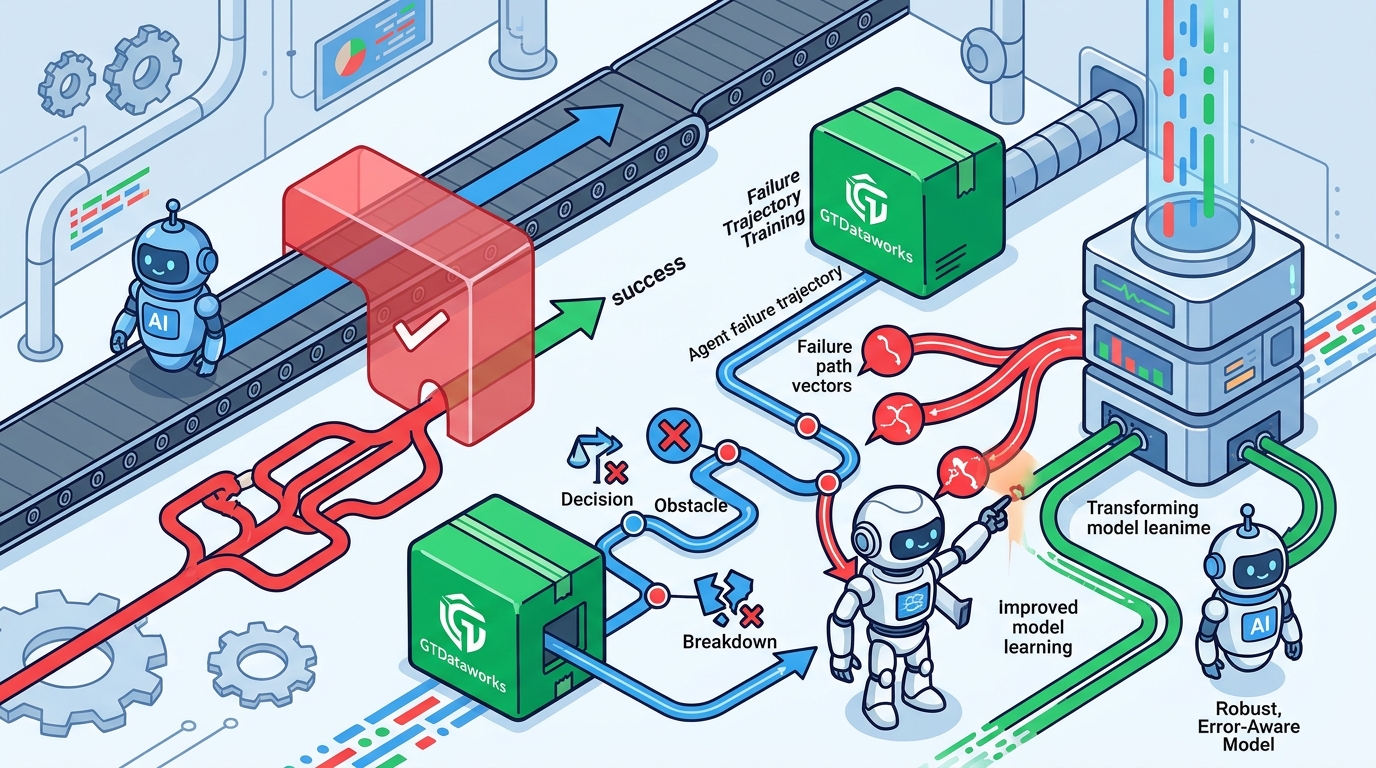
Agent failure trajectories improve AI model training by providing explicit negative examples that teach models to recognize and avoid common error patterns. Instead of smoothing out failures into a single success score, these datasets preserve the exact sequence of actions that led to a breakdown. This approach allows developers to validate models against realistic edge cases. Gold Trace Dataworks builds these evidence-bound datasets to ensure every training row retains its source lineage and execution context. For additional details, review the .
Causal Decomposition of Agent Errors
Understanding why an agent fails is more valuable than knowing that it failed. Recent research in causal decomposition shows that Large Language Model (LLM) agents degrade significantly as trajectories lengthen. This degradation often stems from context management issues rather than a lack of core reasoning ability. By isolating the specific state where the agent lost track of its goal, developers can target the exact weakness. This precision is critical for building robust systems that do not collapse under long-horizon tasks. according to Causal Decomposition of For additional details, review the Customer Experience.
Generating Hard Negatives from Failures
Standard training data often consists of successful examples, which can lead to a model that is overly confident in its own outputs. A co-evolving agents framework addresses this by autonomously generating informative hard negatives from failure trajectories. These hard negatives are examples that are very similar to correct answers but contain subtle errors. Training on these examples forces the model to learn the boundaries of correct behavior more sharply. For additional details, review the Frequently Asked Questions.
This technique is particularly effective for validation. When a model is tested against a set of hard negatives, it reveals whether the model has truly learned the task or merely memorized the surface features of successful runs. The research indicates that using failure trajectories as hard negatives significantly enhances the model's ability to distinguish between valid and invalid actions in complex environments. according to Co Evolving Agents For additional details, review the About.
Cross-Benchmark Transfer and Generalization
A major concern in AI development is whether a model trained on one set of tasks will perform well on unseen tasks. Studies on cross-benchmark transfer from reinforcement learning on agentic coding tasks show that improvements are not limited to the training distribution. Pooled over five independent task sets, significant improvements were observed even on sets released after the training data was collected. This suggests that learning from failure trajectories builds generalizable skills rather than overfitting to specific benchmarks.
The term cross-benchmark transfer is the ability of a model to apply skills learned in one domain to a different, unseen domain. This is a key metric for evaluating the quality of agent datasets. If a dataset only produces models that pass their specific training tests but fail on new tasks, it is not providing high-fidelity training material. Gold Trace Dataworks focuses on creating datasets that support this kind of robust generalization by maintaining strict evidence bounds on every claim.
The Role of Evidence-Bound Data
Many traditional datasets hide the process behind the result. They provide a final answer but strip away the intermediate steps, including the failures. This lack of transparency makes it impossible to audit why a model made a specific decision. Evidence-bound data, on the other hand, keeps the source, transformations, and evaluation status attached to every row. This ensures that when a model is trained on a failure, the context of that failure is fully preserved and verifiable.
Evidence-bound data is a dataset format where every data point includes a record of how it was made, including its source and any limitations. This approach is essential for high-stakes AI applications where accountability is required. By using datasets that do not smooth out inconvenient evidence, developers can build models that are not only accurate but also explainable. This transparency is a core principle of the Gold Trace Dataworks system, which prioritizes witnessed runs and traceable inputs.
Rigorous Validation Through Uncertainty
Validation is often treated as a binary pass-or-fail check. However, this approach misses the nuance of how close a model came to success. By including explicit uncertainty in the training data, models learn to express confidence levels appropriately. This is crucial for safety, as a model that knows when it is unsure is less likely to take risky actions. The preservation of unknown outcomes and failed runs in the record ensures that validation metrics reflect the true capability of the system.
This rigorous approach to validation helps prevent model collapse, a phenomenon where training AI systems on their own data results in degradation rather than improvement. By using external, evidence-bound failure trajectories, developers can avoid the pitfalls of self-referential training loops. This ensures that the model continues to improve over time without losing its foundational capabilities.
Key Takeaways
- Failure trajectories provide explicit negative examples that teach models to recognize and avoid error patterns.
- Causal decomposition helps isolate specific weaknesses in long-horizon tasks, allowing for targeted improvements.
- Hard negatives generated from failures force models to learn the sharp boundaries of correct behavior.
- Cross-benchmark transfer indicates that skills learned from failure data generalize to unseen tasks.
- Evidence-bound data preserves the full context of failures, ensuring transparency and auditability in model training.
- Explicit uncertainty in training data helps models express appropriate confidence levels, enhancing safety.
Frequently Asked Questions
What is an agent failure trajectory?
An agent failure trajectory is a complete record of an AI agent's actions and states leading up to a failed outcome, including the specific steps where the error occurred.
Why are failed runs important for training?
Failed runs provide negative examples that teach models what not to do, helping them learn the boundaries of correct behavior and avoid common pitfalls.
How does causal decomposition work in AI?
Causal decomposition breaks down a complex failure into its contributing factors, allowing developers to identify and address specific weaknesses in the model's reasoning or context management.
What are hard negatives in machine learning?
Hard negatives are training examples that are very similar to correct answers but contain subtle errors, forcing the model to learn fine-grained distinctions.
Does training on failure data improve generalization?
Yes, research shows that models trained on failure trajectories can generalize better to unseen tasks, indicating that they are learning robust skills rather than overfitting to specific benchmarks. according to Cross Benchmark Transfer
What is evidence-bound data?
Evidence-bound data is a dataset format where every data point includes a record of its source, transformations, and evaluation status, ensuring transparency and verifiability.
Conclusion
Agent failure trajectories are a critical component of modern AI development. By preserving the full context of failures, developers can build models that are not only accurate but also robust and explainable. Gold Trace Dataworks provides the curated, evidence-bound datasets necessary to achieve this level of rigor. To explore how these datasets can enhance your AI training and validation processes, visit the Gold Trace Dataworks homepage.