

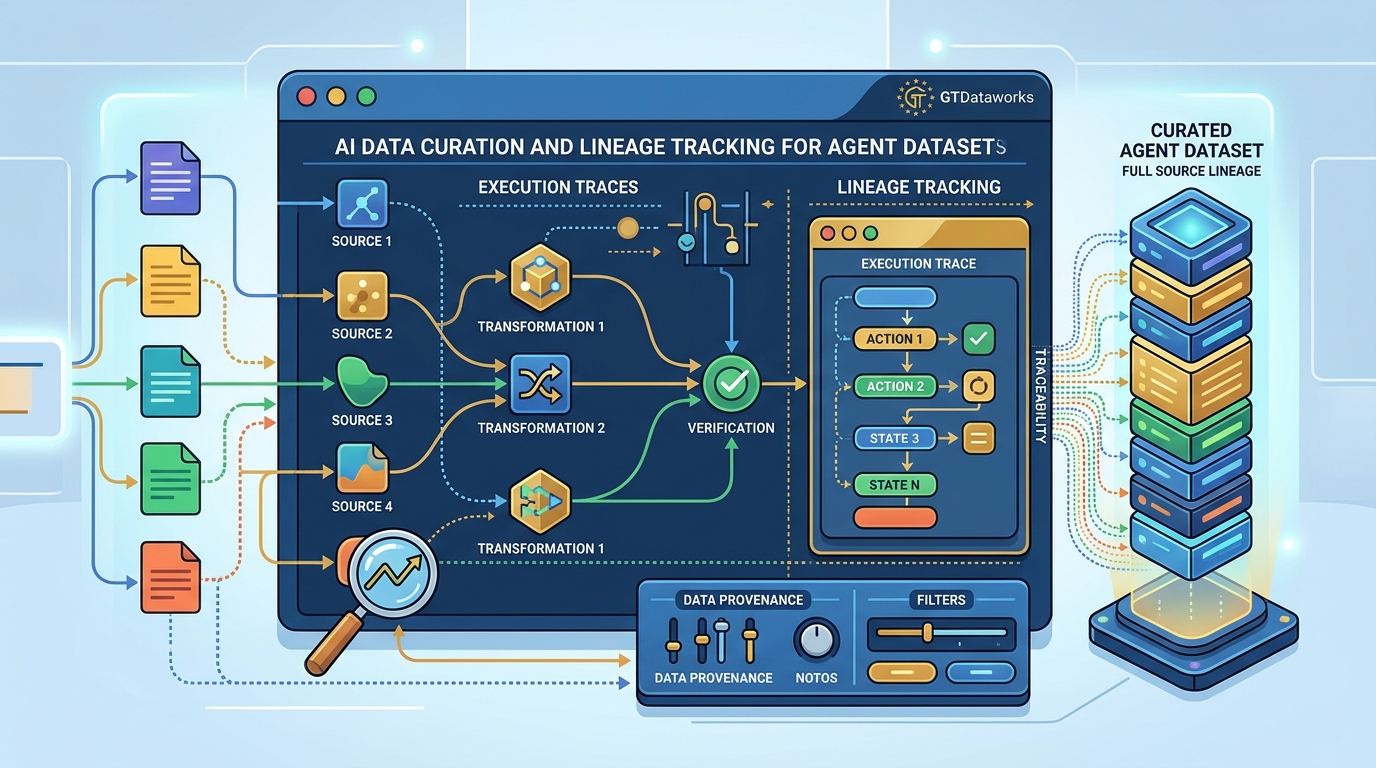
Curated agent datasets with full source lineage are available through specialized platforms like GTDataworks that prioritize data provenance and verifiable execution traces. These datasets ensure every row traces back to its original source and documents all transformations, providing the transparency required for rigorous AI model training and validation. This guide covers the essential components of traceable agent data, including execution traces, lineage tracking, and provenance platforms. For additional details, review the Corey Jacobs QA Engineer.
Agent Execution Traces
Agent execution traces are detailed logs that record the step-by-step actions, decisions, and state changes of an AI agent during a task. Unlike simple input-output pairs, these traces capture the intermediate reasoning processes, tool calls, and environmental interactions that lead to a final result. For developers building autonomous systems, these traces are critical for debugging, safety auditing, and understanding failure modes. For additional details, review the .
The Role of Witnessed Execution
Why Traces Matter for Model Validation
Model validation requires more than just checking final outputs. It requires verifying that the model arrived at the correct output through valid reasoning. Execution traces allow evaluators to inspect the path taken by an agent, identifying potential hallucinations, logical errors, or unsafe actions. By analyzing these traces, teams can pinpoint exactly where a model deviates from expected behavior, enabling targeted improvements in training data and model architecture. For additional details, review the Customer Experience.
Source Lineage Tracking
Source lineage tracking is the process of documenting the origin of data and the sequence of transformations applied to it from its initial collection to its final use in a model. This practice ensures that every data point in a curated dataset can be traced back to its primary source, providing a clear audit trail. In the context of AI development, source lineage is essential for maintaining data integrity and ensuring compliance with regulatory requirements. For additional details, review the Frequently Asked Questions.
Transformations and Data Integrity
Benefits for Reproducibility
Reproducibility is a cornerstone of scientific research and reliable AI development. By maintaining detailed source lineage, teams can reproduce the exact conditions under which a dataset was created. This allows for consistent benchmarking and validation across different models and environments. It also facilitates collaboration, as other researchers can verify the data's provenance and trust its integrity. For additional details, review the About.
Data Provenance Platforms
Data provenance platforms are specialized tools and services that manage, store, and query the metadata associated with data lineage and execution traces. These platforms provide the infrastructure needed to handle the complexity of modern AI datasets, where data points are often derived from multiple sources and undergo numerous transformations. They enable developers to query not just the data itself, but the history and context behind it.
Key Features of Provenance Platforms
Choosing the Right Platform
| Source Lineage | Often missing or incomplete | Full traceability to primary sources |
| Execution Traces | Rarely included | Witnessed execution logs included |
| Uncertainty Metrics | Not typically provided | Explicit uncertainty bounds |
| Reproducibility | Difficult to ensure | Highly reproducible with documented transformations |
Key Takeaways
- Agent execution traces provide detailed logs of an AI agent's actions and reasoning, essential for debugging and safety auditing.
- Witnessed execution ensures that dataset entries represent actual, observed behavior in a controlled environment.
- Source lineage tracking documents the origin and transformations of data, ensuring integrity and compliance.
- Data provenance platforms manage the metadata associated with lineage, enabling complex queries and automated checks.
- Choosing the right provenance platform depends on scalability, compatibility, and the level of detail required.
Frequently Asked Questions
What is the primary benefit of using curated agent datasets with source lineage?
The primary benefit is the ability to verify the integrity and origin of every data point, ensuring that models are trained on reliable and transparent data.
How do witnessed execution traces differ from standard input-output pairs?
Witnessed execution traces capture the intermediate steps and decisions of an agent, whereas standard pairs only show the final input and output.
Why is explicit uncertainty important in AI datasets?
Explicit uncertainty allows models to understand the confidence level of each data point, leading to more robust and reliable predictions.
Can data provenance platforms integrate with existing ML pipelines?
What role does GTDataworks play in AI evaluation?
How does source lineage tracking help with regulatory compliance?
It provides an audit trail that demonstrates how data was collected and processed, which is often required for compliance with data protection regulations.
Conclusion
Accessing curated agent datasets with full source lineage is no longer optional for serious AI development. It is a fundamental requirement for building transparent, reliable, and safe AI systems. By leveraging platforms like GTDataworks, developers can ensure that every data point in their training and validation sets is traceable, verifiable, and accompanied by explicit uncertainty metrics. This approach not only enhances model performance but also builds trust with stakeholders and regulators. As the AI landscape continues to evolve, the demand for high-fidelity, provenance-rich datasets will only grow. GTDataworks remains at the forefront of this movement, providing the tools and data necessary for the next generation of AI innovation.