

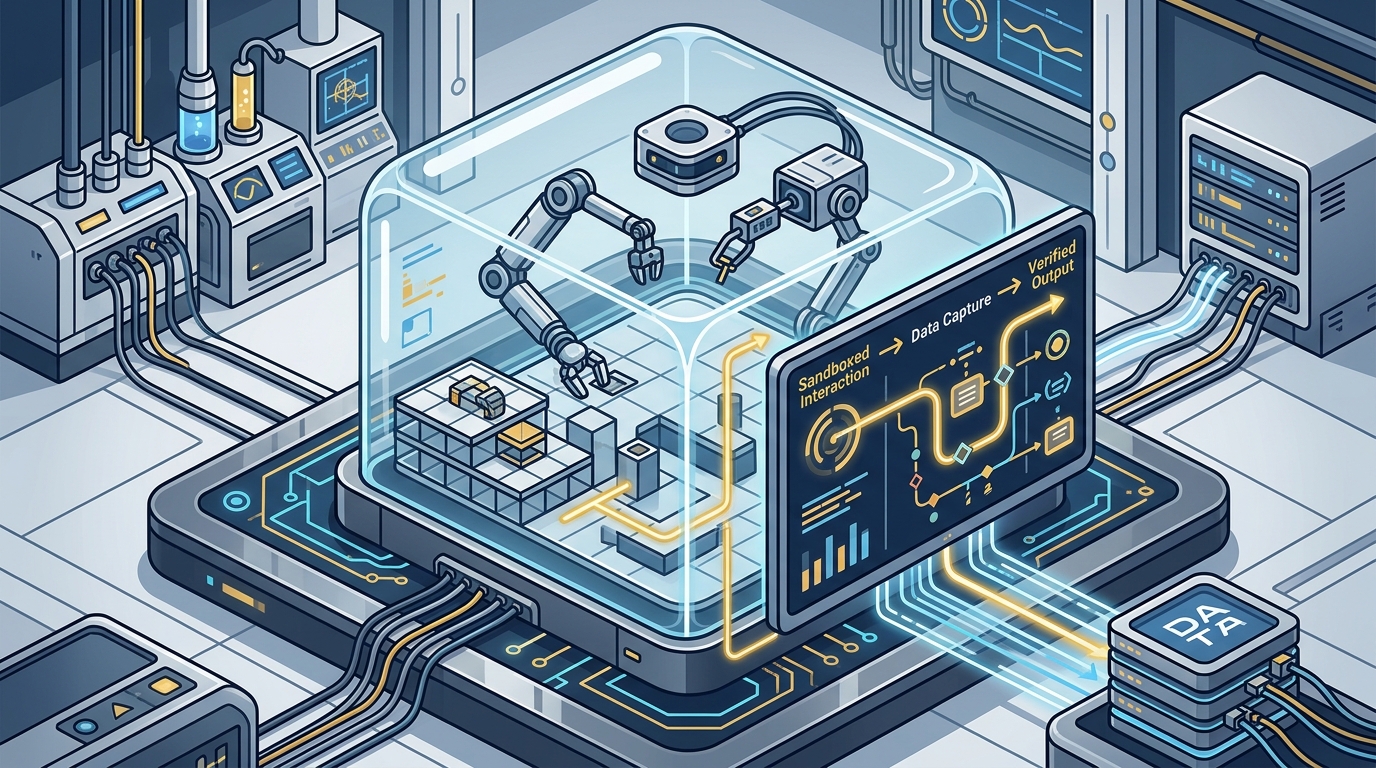
Sandboxed environments isolate agent actions within controlled boundaries, preventing real-world side effects during data generation. This isolation ensures that every interaction is reproducible, verifiable, and free from external noise. By restricting the actor to an owned environment, developers can capture high-fidelity execution traces that accurately reflect agent decision-making. This approach directly enhances the reliability of training datasets used for model validation and benchmarking. For additional details, review the Corey Jacobs QA Engineer.
Isolation Prevents Contamination of Training Signals
When agents operate in open systems, external variables can introduce noise into the data collection process. A sandboxed environment is a restricted computing space that limits an agent's access to specific resources and APIs. This containment ensures that the only variables influencing the agent's behavior are those explicitly defined by the test scenario. For example, if an agent is trained to book a flight, a sandbox prevents it from actually purchasing tickets or modifying user profiles. This isolation guarantees that the resulting dataset contains pure decision logic rather than accidental side effects. For additional details, review the Customer Experience.
Reproducibility Enables Rigorous Validation
Reliable AI systems require training data that can be consistently reproduced. In a sandbox, every execution trace is witnessed and recorded with full source lineage. This means that if a model fails a benchmark test, engineers can replay the exact same scenario to diagnose the failure. The reproducibility of sandboxed data allows for A/B testing of different model architectures against identical inputs. Without this level of control, debugging complex agent behaviors becomes a guessing game. GTDataworks emphasizes this principle by ensuring that every data point in their curated datasets is traceable to a specific, witnessed execution event. For additional details, review the Frequently Asked Questions.
Explicit Uncertainty Improves Model Calibration
Evidence-Bound Claims Enhance Trustworthiness
Modern AI agents are expected to justify their actions with verifiable evidence. Sandboxed environments facilitate the creation of evidence-bound claims by logging the specific data points that led to each decision. This transparency is critical for applications in regulated industries where audit trails are mandatory. By linking every claim to its source data within the sandbox, developers can verify that the agent is not hallucinating information. This level of rigor is essential for building trust in autonomous systems that operate in high-stakes environments. For additional details, review the About.
Scalability of High-Fidelity Data Generation
Generating large volumes of high-quality training data is a significant challenge for AI developers. Sandboxed environments enable the parallel execution of thousands of agent scenarios simultaneously. This scalability allows for the rapid creation of diverse training datasets without the risks associated with live production systems. The ability to scale data generation while maintaining strict quality controls is a key advantage of sandboxed approaches. It enables teams to iterate quickly on agent designs and validate improvements before deploying to real-world settings.
Key Takeaways
- Sandboxed environments isolate agent actions to prevent real-world side effects during data generation.
- Reproducibility in sandboxed data allows for rigorous debugging and validation of model performance.
- Explicit uncertainty markers in training data improve model calibration and confidence estimation.
- Evidence-bound claims ensure that agent decisions are traceable and verifiable.
- Scalable sandboxing enables the rapid generation of diverse, high-fidelity training datasets.
- Isolation ensures that training signals reflect pure decision logic rather than external noise.
Frequently Asked Questions
What is a sandboxed environment in AI agent training?
A sandboxed environment is a restricted computing space that isolates an agent's actions from real-world systems, allowing for safe and reproducible data generation.
Why is reproducibility important for agent training data?
Reproducibility allows engineers to replay exact scenarios to diagnose failures and validate model improvements, ensuring that training data is reliable and consistent.
How do sandboxes help with model calibration?
Sandboxes allow developers to inject controlled uncertainty into scenarios, helping agents learn to express confidence levels in their predictions.
What is an evidence-bound claim?
An evidence-bound claim is a statement made by an agent that is directly linked to specific, verifiable data points from its execution trace.