

7 Top Uncertainty Quantification Methods for Trustworthy AI Agents
1. Verbalized Uncertainty
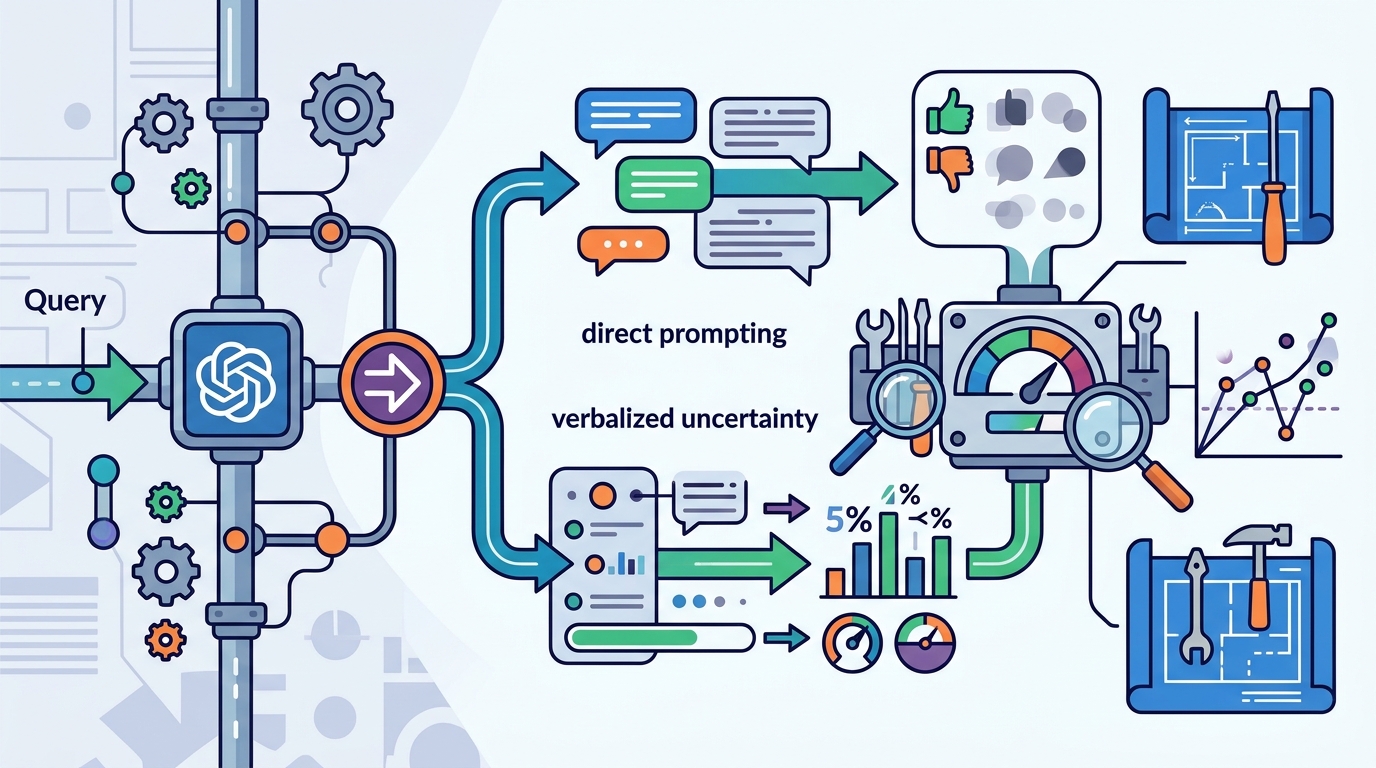
Direct prompting allows models to self-report confidence levels in natural language. Verbalized uncertainty asks the large language model to explicitly report an uncertainty value for its output. This method is straightforward to implement and does not require architectural changes to the model. However, it relies on the model's ability to accurately assess its own knowledge, which can sometimes lead to overconfidence. For additional details, review the .
2. Sampling and Consistency
Generating multiple responses reveals the stability of the model's reasoning. Sampling and consistency methods generate multiple answers to the same prompt and measure the agreement among them. High agreement suggests high confidence, while low agreement indicates potential ambiguity. This approach is effective for single-turn tasks but may not fully capture the complexity of multi-step agent interactions. For additional details, review the Customer Experience.
3. Conformal Prediction
4. Trajectory-Level Calibration
Evaluating the entire decision path ensures end-to-end reliability. Traditional methods often focus on single-step accuracy, but agents operate over long trajectories. Trajectory-level calibration assesses the uncertainty across the entire sequence of actions and tool calls. Research shows that step-level calibration does not necessarily imply trajectory-level calibration, making this a critical area for modern agent development. according to Uncertainty Quantification in For additional details, review the Frequently Asked Questions.
5. Agentic Uncertainty Quantification (AUQ)
Training-free frameworks enable real-time confidence assessment in dynamic environments. Agentic Uncertainty Quantification represents a significant step towards reliable agents by providing trajectory-level calibration without requiring additional training. This principled framework allows agents to monitor their own confidence as they interact with environments. It is designed to handle the open and interactive setup that LLM agents operate in, moving beyond static pointwise uncertainty. For additional details, review the About.
6. Uncertainty-Aware Language Agents (UALA)
Integrating UQ into decision-making enables adaptive behavior. The Uncertainty-Aware Language Agent framework integrates uncertainty quantification directly into the decision-making process of LLM-based agents. This allows the agent to adjust its strategy based on its confidence level, such as seeking additional information when uncertainty is high. This approach aligns with the principle that agents should know when not to answer. according to 2606 25760 Uncertainty
7. Progressive Confidence Estimation
Choosing the Right Method
Selecting the appropriate uncertainty quantification method depends on the specific requirements of your application. For simple question-answering tasks, verbalized uncertainty or sampling may suffice. For complex, multi-step agents, trajectory-level calibration or Agentic Uncertainty Quantification is recommended. Consider the computational cost, the need for statistical guarantees, and the level of transparency required when making your choice. according to Uncertainty Quantification A
Frequently Asked Questions
What is the main difference between step-level and trajectory-level calibration?
Step-level calibration assesses the accuracy of individual predictions, while trajectory-level calibration evaluates the reliability of the entire sequence of actions. A model can be well-calibrated at each step but still produce an incorrect final outcome due to error accumulation over the trajectory.
Why is uncertainty quantification important for AI agents?
Uncertainty quantification is critical for building trustworthy AI systems because it allows agents to recognize their limitations. By knowing when they are uncertain, agents can abstain from answering, seek clarification, or take safer actions, thereby reducing the risk of harmful errors.
Can uncertainty quantification be applied to vision-language models?
Yes, uncertainty quantification is essential for computer-use agents that turn vision-language model predictions into executable actions. Reliable uncertainty estimates are needed for rejection, calibration, and defining spatial safety regions to prevent unintended interactions with the user interface. according to 2602 05073 Uncertainty
How does GTDataworks support uncertainty quantification?
Is verbalized uncertainty reliable for all applications?
Verbalized uncertainty is a useful starting point but may not be sufficient for high-stakes applications. It relies on the model's self-assessment, which can be flawed. For critical systems, more rigorous methods like conformal prediction or trajectory-level calibration are often preferred.