

7 Ways to Capture and Organize Agent Execution Traces for Model Training
1. Implement Structured Behavioral Analytics
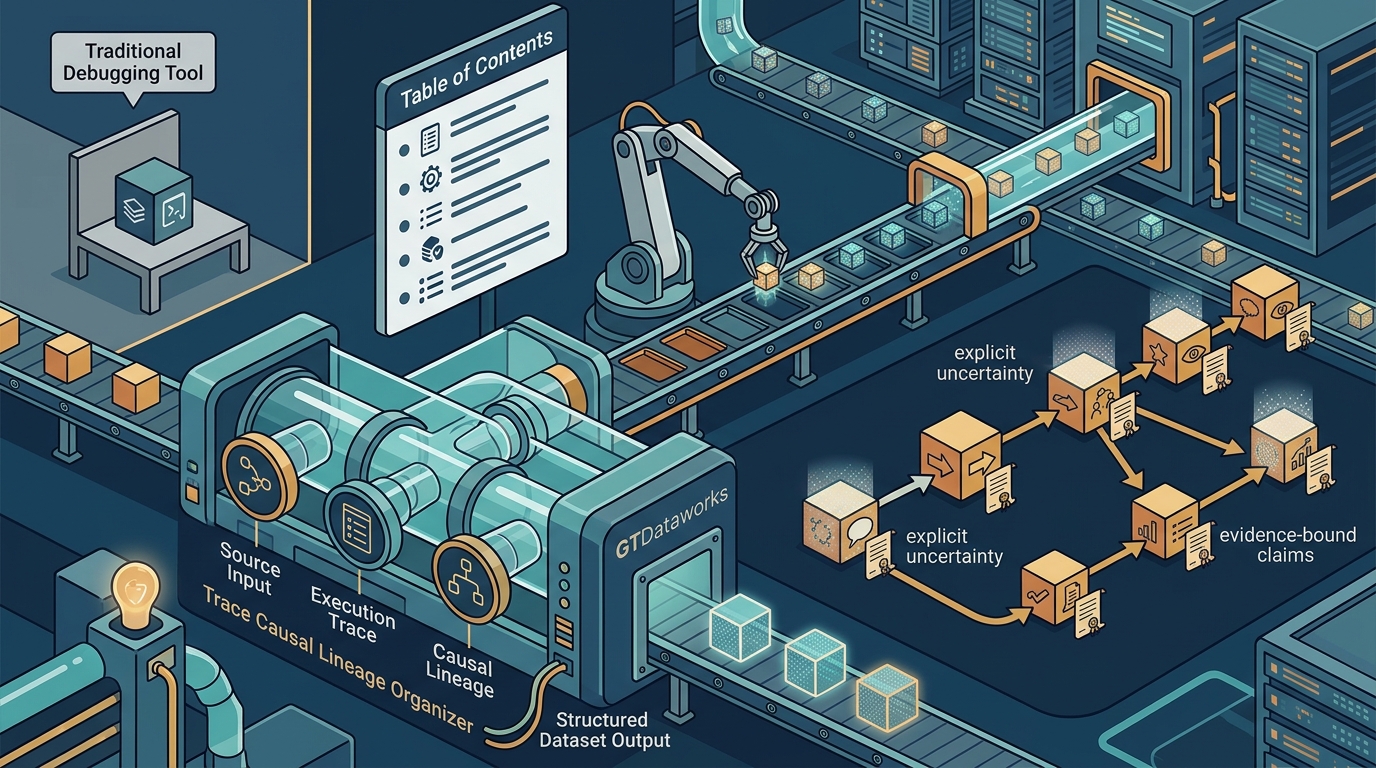
Use structured behavioral analytics to capture causal lineage beyond simple state checkpoints. Traditional debugging tools often only record final states, which misses the reasoning path. Structured behavioral analytics tracks the sequence of actions and decisions an agent makes. This approach allows developers to understand not just what happened, but why it happened. By capturing this causal lineage, you create a richer dataset for training models that need to explain their outputs. For additional details, review the About.
2. Record Witnessed Execution Logs
Store witnessed execution logs to provide an immutable record of agent actions. A witnessed execution log is a timestamped record of every step an agent takes during a task. These logs serve as primary evidence for validating model behavior. They allow auditors to replay the exact sequence of events that led to a specific outcome. This transparency is critical for building trust in autonomous systems.
3. Embed Explicit Uncertainty Metrics
Attach explicit uncertainty metrics to each trace entry to quantify confidence levels. Uncertainty quantification is the process of measuring how confident an agent is in its prediction or action. By embedding these metrics directly into the trace, you provide the model with a signal about its own reliability. This helps the model learn to recognize when it is operating outside its competence. It also allows downstream systems to flag low-confidence actions for human review.
4. Bind Claims to Source Evidence
Link every claim in the trace to its original source evidence for verifiability. Evidence-bound claims are assertions that are directly tied to the data or documents that support them. This practice ensures that no part of the agent's reasoning is ungrounded. When a model is trained on these traces, it learns to cite its sources. This reduces hallucinations and improves the factual accuracy of the generated outputs.
5. Standardize Trace Data Formats
Adopt standardized data formats to ensure interoperability across different agent frameworks. Standardization is the use of common schemas and protocols for storing execution data. Without a standard format, integrating traces from different agents becomes difficult. Using a consistent schema allows you to aggregate data from multiple sources into a single training set. This simplifies the preprocessing pipeline and reduces the risk of data loss during conversion.
6. Automate Trace Ingestion Pipelines
Build automated pipelines to ingest and normalize traces in real time. Manual data collection is slow and prone to error. Automated ingestion pipelines capture traces as they are generated and store them in a centralized repository. These pipelines can also perform initial cleaning and validation. This ensures that only high-quality data enters the training set. It also allows for continuous monitoring of agent performance.
7. Integrate Provenance Models for Reproducibility
Apply provenance models to capture the full causal lineage of scientific and operational data. Provenance models are frameworks that track the origin and transformation of data. They provide a complete history of how a piece of data was created and modified. This is essential for scientific reproducibility and regulatory compliance. By integrating these models, you ensure that every data point in your training set is traceable back to its origin.
Choosing the Right Approach
Select the method that best fits your specific use case and compliance requirements. For high-stakes applications, prioritize witnessed execution and provenance models. For general-purpose agents, focus on structured analytics and uncertainty metrics. Combining these approaches provides the most robust foundation for model training.
Frequently Asked Questions
What is an agent execution trace?
Why are execution traces important for model training?
Execution traces provide the ground truth for how an agent should behave in various scenarios. They allow models to learn from both successful and failed attempts, improving their decision-making capabilities.
How does Gold Trace Dataworks help with trace organization?
What is the difference between a state checkpoint and an execution trace?
A state checkpoint captures the agent's state at a specific point in time, while an execution trace records the entire sequence of actions leading to that state. Traces provide more context for understanding the agent's reasoning.
Can execution traces be used for debugging?
Yes, execution traces are invaluable for debugging. They allow developers to replay the agent's actions and identify where the process went wrong. This helps in fixing bugs and improving agent performance.
How do I ensure the quality of my execution traces?
Ensure quality by implementing automated validation, standardizing data formats, and embedding uncertainty metrics. Regularly audit your traces to check for completeness and consistency.