

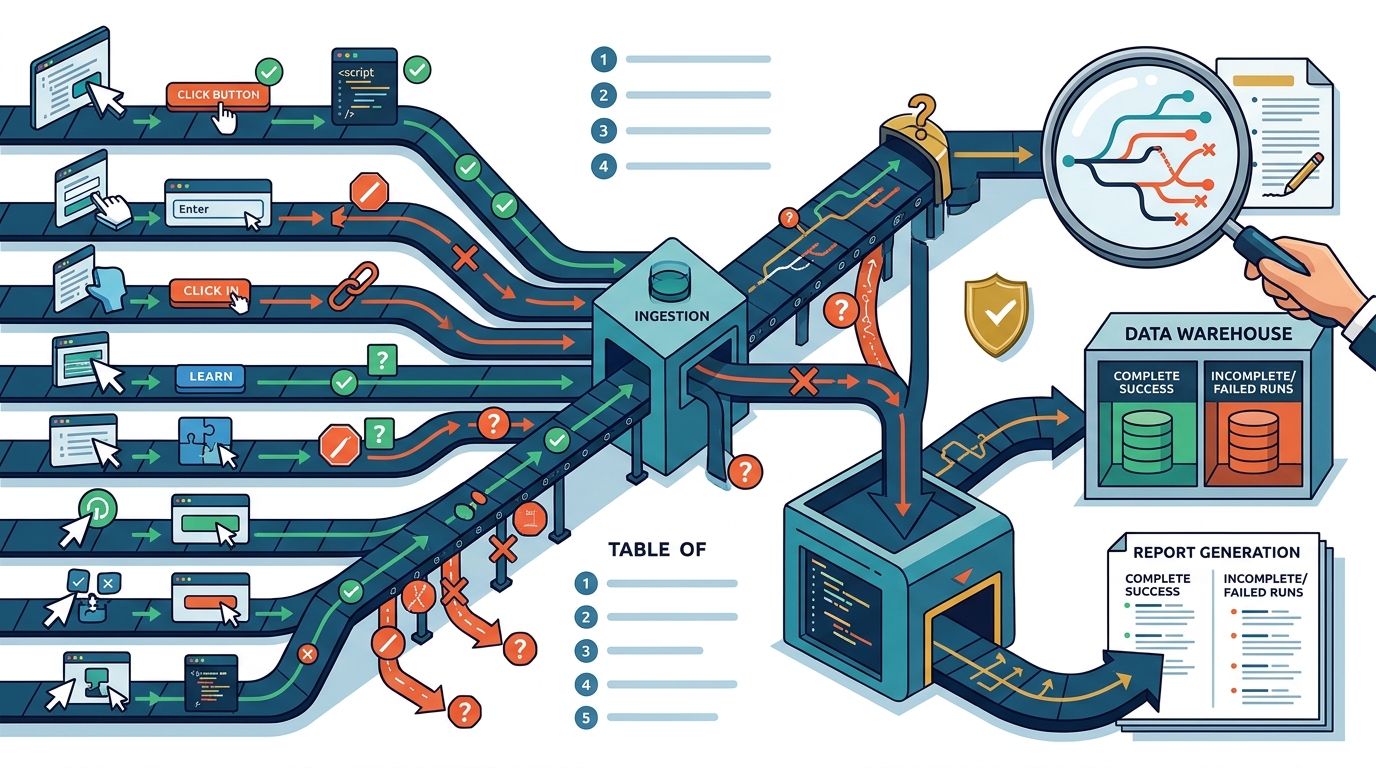
Most public agent datasets discard failed executions, creating a blind spot in model training. Gold Trace Dataworks addresses this gap by preserving the full execution record, including unknown outcomes and failed runs. This approach ensures that the data reflects the true complexity of agent behavior rather than a curated success story.
1. Search for Explicit Uncertainty Markers
Look for datasets that label unknown outcomes rather than smoothing them into success scores. Incomplete trip estimation is a known challenge in data science, where missing data points can skew results. In the context of agent trajectories, explicit uncertainty markers indicate that the dataset retains runs where the final state is unknown. This transparency allows developers to train models that handle ambiguity gracefully.
2. Verify Source Lineage Metadata
Ensure every data row retains its source, transformations, and rights status. Source lineage is the record of how a data point was created and modified. Without this metadata, it is impossible to verify the integrity of the training data. Gold Trace Dataworks emphasizes that every row keeps its source attached, which is critical for auditing and compliance in high-stakes AI applications.
3. Filter for Witnessed Execution Logs
Prioritize datasets that include witnessed runs over simulated or inferred data. A witnessed run is an execution that was observed and recorded in real-time, providing a ground truth for the agent's behavior. Simulated data can be useful, but it often lacks the stochastic noise of real-world interactions. By filtering for witnessed execution logs, you ensure that your model learns from actual operational conditions.
4. Check for Structural Validator Reports
Confirm that the dataset passes structural validation before ingestion. Structural validation is the process of checking data against a predefined schema to ensure consistency. A dataset that passes its structural validator provides a baseline of reliability. This step is crucial when integrating new data into existing pipelines, as it prevents schema mismatches that can cause downstream failures.
5. Review Failure Taxonomy Annotations
Use datasets that categorize failures systematically rather than leaving them unexplained. A failure taxonomy is a structured classification system for different types of agent errors. Systematic annotation allows developers to analyze specific failure modes, such as hallucination or tool misuse. This level of detail is essential for targeted model improvement and debugging.
6. Assess Reproducibility Metadata
7. Evaluate Evidence-Bound Claim Structures
Ensure that claims in the dataset are bound to specific evidence rather than general assertions. An evidence-bound claim is a statement that is directly supported by a specific piece of data or observation. This structure prevents the propagation of hallucinations in the training data. By using evidence-bound claims, you create a dataset that is both rigorous and verifiable.
Choosing the Right Dataset
Select a dataset based on the specific failure modes you need to address. If your primary concern is hallucination, prioritize datasets with strong evidence-bound claim structures. If you are focused on operational reliability, look for datasets with comprehensive reproducibility metadata and witnessed execution logs. according to Diagnosing with Insights
Frequently Asked Questions
Why are incomplete runs important in agent datasets?
Incomplete runs provide a realistic view of agent behavior, including failures and unknown outcomes. This helps models learn to handle uncertainty and avoid overfitting to successful cases.
What is source lineage in the context of agent data?
Source lineage is the record of how a data point was created, transformed, and evaluated. It ensures transparency and allows for auditing of the data's integrity.
How does Gold Trace Dataworks handle failed runs?
Gold Trace Dataworks keeps failed runs and unknown outcomes in the record instead of smoothing them into a success score. This approach ensures that the dataset reflects the true complexity of agent execution.
What is a witnessed run?
A witnessed run is an execution that was observed and recorded in real-time. It provides a ground truth for the agent's behavior, which is essential for rigorous model training.
Why is structural validation important for agent datasets?
Structural validation ensures that the data conforms to a predefined schema. This prevents inconsistencies that can cause downstream failures in machine learning pipelines.