

Execution traces provide a detailed record of an AI agent's decision-making process, capturing every step from input to output. This transparency allows developers to understand exactly how an agent behaves, identifies failures, and validates results. Gold Trace Dataworks leverages these traces to create high-fidelity datasets that ensure reliability in modern AI systems.
1. Enhanced Debugging and Failure Analysis
Traces allow developers to pinpoint exactly where a workflow failed. Model operators can replay a failed workflow by inspecting the trace to see where a retrieval step, tool failure, or policy rejection altered the agent's path. This capability is crucial for identifying root causes rather than just symptoms. It transforms debugging from a guessing game into a precise diagnostic process.
2. Improved Model Interpretability
Visualizing execution traces exposes the internal logic of complex agents. Research indicates that visual traces allow users to examine how results are produced and better understand agent behavior across different stages of the research process. This visibility helps teams trust the system by seeing the reasoning behind specific outputs. It bridges the gap between black-box models and human understanding.
3. Rigorous Security and Threat Detection
Execution traces enable the detection of adversarial patterns in agent behavior. Threat researchers compare execution traces against known adversarial patterns in the MITRE ATLAS adversarial AI threat matrix to understand how attack techniques influence agent behavior. This proactive approach helps secure agents against manipulation and data exfiltration. It ensures that safety constraints are not just theoretical but practically enforced. according to What Is Agent
4. High-Fidelity Training Data Generation
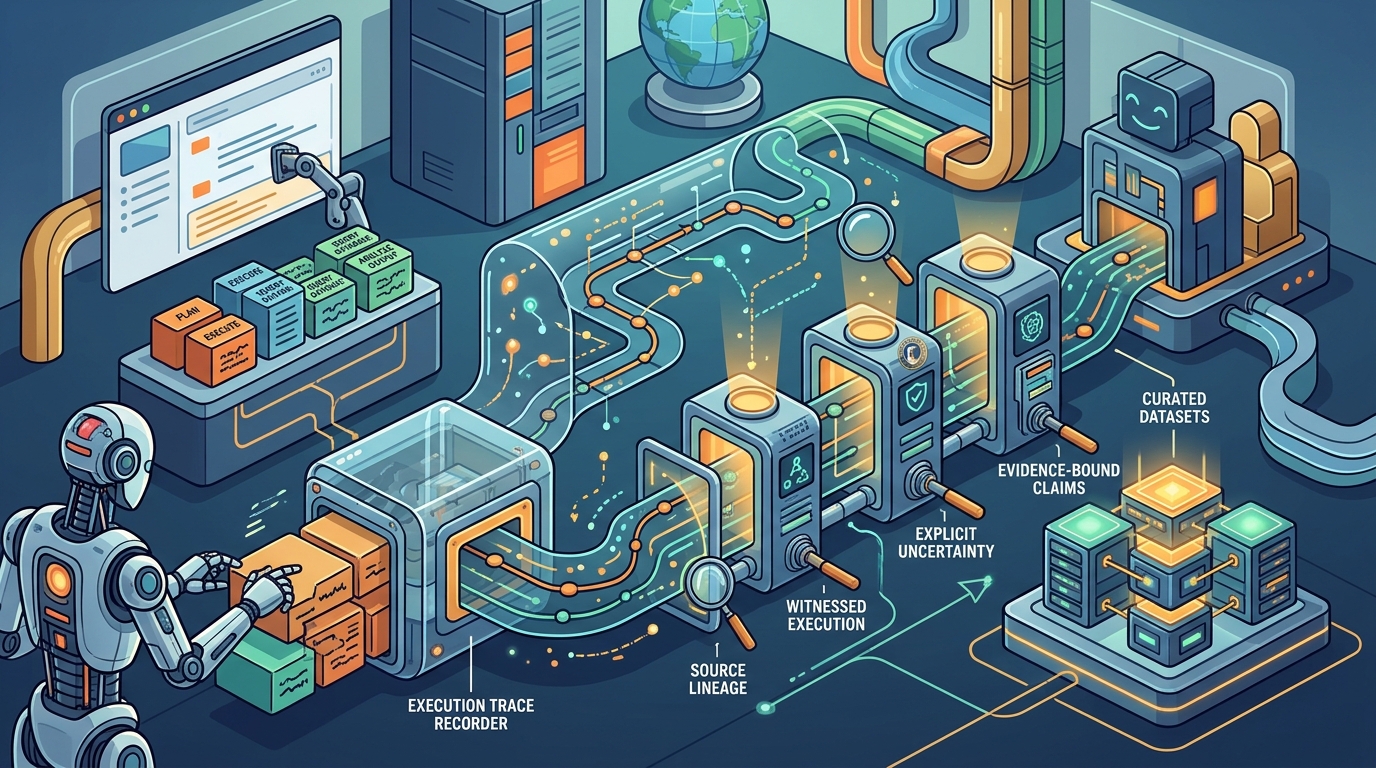
Traces provide the raw material for creating curated, evidence-bound datasets. Gold Trace Dataworks turns agent runs and contained simulations into curated datasets where every row keeps its source, transformations, evaluation, rights status, and limits attached. This ensures that training data is not just accurate but also verifiable. It supports rigorous model training by providing context that standard outputs lack.
5. Validation of Tool-Use Safety
Traces verify that agents adhere to safety protocols when using external tools. A survey of evidence tracing and execution provenance highlights that observability is necessary in settings involving tool-use safety. By recording how an agent interacts with tools, developers can confirm that permissions are respected and actions are within bounds. This is critical for deploying agents in real-world environments where errors can have significant consequences.
6. Standardization of Evaluation Metrics
Traces provide a consistent basis for benchmarking agent performance. When evaluation protocols record and represent execution steps, they allow for fair comparisons between different models or versions. This standardization helps teams identify which architectural changes actually improve performance. It moves evaluation beyond simple accuracy scores to a more holistic view of agent capability.
7. Preservation of Uncertainty and Limits
Traces explicitly capture uncertainty and operational limits in agent runs. Failed runs, unknown outcomes, and inconvenient evidence stay in the record instead of being smoothed into a success score. This honesty in data representation prevents overfitting to ideal scenarios. It ensures that models are trained to handle ambiguity and failure gracefully, leading to more robust real-world performance.
Choosing the Right Trace Strategy
Selecting the right approach to execution traces depends on your specific development goals. If your primary focus is security, prioritize detailed tool-use logs and adversarial pattern matching. If your goal is improving model reasoning, focus on visualizing intermediate steps and decision points. For teams building foundational datasets, ensure that your trace pipeline captures source lineage and explicit uncertainty. Gold Trace Dataworks offers a structured system for managing these traces, ensuring that every data point is traceable and verifiable. By aligning your trace strategy with your specific needs, you can maximize the value of your agent development efforts.
Frequently Asked Questions
What is an agent execution trace?
An agent execution trace is a detailed log of the steps an AI agent takes to complete a task, including inputs, tool calls, and intermediate outputs.
Why are execution traces important for AI safety?
Execution traces are important for AI safety because they allow researchers to detect adversarial patterns and verify that agents adhere to safety protocols during tool use. according to Graph of Trace
How does Gold Trace Dataworks use execution traces?
Gold Trace Dataworks uses execution traces to create curated datasets that include source lineage, witnessed execution, and explicit uncertainty for rigorous model training.
Can execution traces improve model debugging?
Yes, execution traces improve model debugging by allowing developers to replay failed workflows and identify exactly where a retrieval step or tool failure altered the agent's path.
What is the difference between a trace and a final output?
A final output is the end result of an agent's task, while a trace records the entire process, including intermediate steps, decisions, and potential failures.
How do traces help with benchmarking AI agents?
Traces help with benchmarking by providing a consistent record of execution steps, allowing for fair comparisons of performance and reliability across different models.