

Execution Traces: Process-Level Transparency
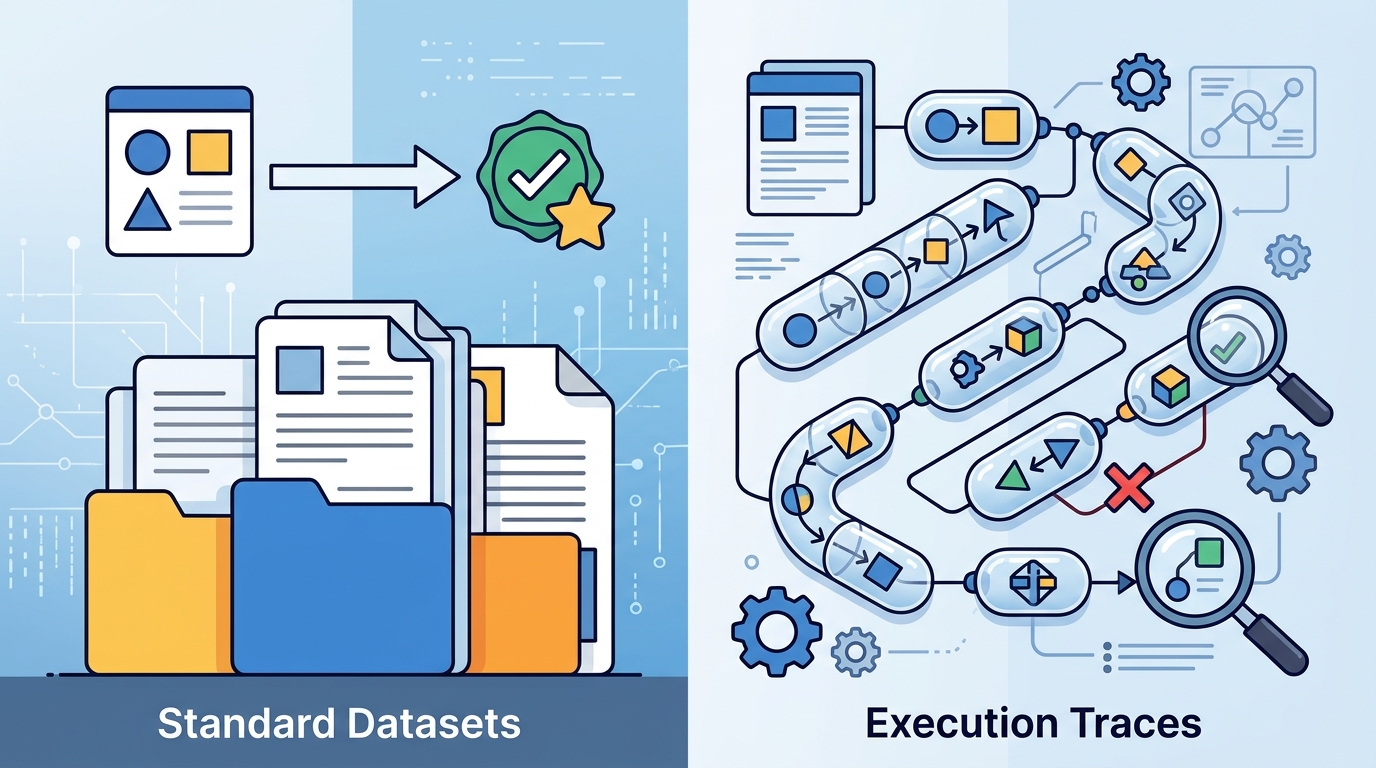
Execution traces are detailed logs of an AI agent's step-by-step actions, decisions, and intermediate states during a task. Unlike static datasets that only record inputs and final outputs, traces reveal the "why" behind an agent's behavior. This process-level transparency is critical for debugging complex, multi-step workflows. When an agent fails, a trace allows engineers to pinpoint the exact step where the logic diverged from the expected path. according to 2609 06063 Explaining For additional details, review the Customer Experience.
Strengths of Execution Traces
Limits and Challenges
However, raw execution traces can be difficult for humans to inspect and review. Scientific AI agents can autonomously carry out complex research workflows, yet these unfolded workflows often remain difficult to interpret without specialized visualization tools. The volume of data in a single trace can be overwhelming, requiring robust tooling to make sense of the sequence of events. Without proper curation, traces may contain noise or irrelevant steps that obscure the core decision logic. For additional details, review the Frequently Asked Questions.
Who It Suits
Execution traces are best suited for machine learning engineers and AI developers working on autonomous systems that require rigorous validation. They are essential for teams that need to demonstrate auditability to stakeholders or regulatory bodies. If your application involves financial transactions, medical advice, or other high-risk domains, the granular detail provided by traces is indispensable. according to 2609 06063 Explaining For additional details, review the About.
Standard Training Datasets: Scale and Simplicity
Standard training datasets are collections of input-output pairs used to teach models general patterns and behaviors. These datasets are typically static, meaning they do not capture the dynamic process of how a model arrived at its answer. They are widely used because they are easier to generate, store, and process at scale. For many general-purpose tasks, standard datasets provide sufficient signal for a model to learn effective behaviors.
Strengths of Standard Datasets
The main advantage of standard datasets is their simplicity and scalability. They are easier to create and manage than detailed execution traces, making them accessible for a broader range of development teams. Standard datasets allow for rapid iteration and training cycles, which is valuable in fast-moving development environments. They are also more compatible with existing machine learning pipelines that are not designed to handle complex, sequential data.
Limits and Challenges
The significant limitation of standard datasets is the lack of process visibility. If a model produces an incorrect output, a standard dataset does not explain why the error occurred. This makes debugging and mitigation strategies difficult to develop. Furthermore, standard datasets may not capture the uncertainty or confidence levels of the model, which is crucial for building reliable agents that know when to ask for help or defer to a human.
Who It Suits
Standard datasets are suitable for teams building general-purpose AI models where the focus is on broad capability rather than specific, auditable workflows. They are a good starting point for prototyping and initial training phases. However, they are less effective for applications where every decision must be traceable and verifiable.
Comparison of Execution Traces and Standard Datasets
| Criteria | Execution Traces | Standard Training Datasets |
|---|---|---|
| Process Visibility | High (step-by-step reasoning) | Low (input-output only) |
| Debugging Capability | Excellent (pinpoints failure steps) | Limited (no intermediate data) |
| Data Complexity | High (requires specialized tooling) | Low (easy to process) |
| Scalability | Moderate (storage intensive) | High (easy to scale) |
| Auditability | Strong (evidence-bound claims) | Weak (opaque decision process) |
| Best Use Case | High-stakes, autonomous agents | General-purpose model training |
Choosing the Right Data Strategy
Selecting the right data format depends on your specific application requirements and risk tolerance. Understanding the trade-offs between process transparency and data simplicity is key to building reliable AI systems.
Choose Execution Traces If
Choose Standard Datasets If
You are developing general-purpose models where the focus is on broad capability and rapid iteration. Your application does not require step-by-step auditability, and the cost of detailed tracing outweighs the benefits. You are in the early prototyping phase and need to establish baseline performance before moving to more complex data formats.
Frequently Asked Questions
Can standard datasets be converted into execution traces?
No, standard datasets typically only contain input-output pairs and do not capture the intermediate reasoning steps. Converting them into execution traces would require re-running the agent with logging enabled, which is not possible with static data alone.
What is the main advantage of witnessed execution in datasets?
Witnessed execution ensures that the data points in the dataset are verified and traceable to their source. This adds a layer of reliability and trust, which is critical for training models that need to make accurate and auditable decisions.
How do execution traces help with debugging AI agents?
Execution traces provide a step-by-step log of an agent's actions and decisions. This allows developers to pinpoint exactly where a failure occurred, making it easier to identify and fix bugs in the agent's logic.
Are execution traces more expensive to store than standard datasets?
Yes, execution traces are generally more data-intensive because they capture detailed, sequential information. This can lead to higher storage and processing costs compared to standard input-output datasets.
What role does explicit uncertainty play in agent training?
Explicit uncertainty allows agents to express their confidence levels in their decisions. This is crucial for building reliable systems that can recognize when they are unsure and defer to human oversight or request additional information.