

OpenLineage is an open standard for collecting and storing lineage data across data pipelines. It provides a unified way to track the flow of data from source to destination, which is critical for AI training environments. By implementing OpenLineage, teams at GTDataworks can ensure that every dataset used for model training is fully traceable and verifiable. For additional details, review the Corey Jacobs QA Engineer.
1. Standardized Event Schema
Consistent data structure across all tools. The OpenLineage specification defines a strict JSON schema for lineage events. This ensures that whether data is processed by Spark, Airflow, or a custom Python script, the resulting lineage metadata remains uniform. This consistency allows for seamless integration with various data catalogs and observability platforms. For additional details, review the Customer Experience.
2. Job and Run Identification
Unique tracking of pipeline executions. Every pipeline execution is identified by a unique Job ID and Run ID. The Job ID represents the logical definition of the task, while the Run ID tracks a specific instance of that task. This distinction is vital for debugging AI training runs where multiple iterations of the same data preparation job may occur. For additional details, review the Frequently Asked Questions.
3. Dataset Facets
4. Integration with Existing Orchestration
Non-invasive instrumentation of workflows. The standard is designed to integrate with existing orchestration tools like Apache Airflow and Dagster. It does not require rewriting pipeline logic but rather adds a layer of metadata collection. This makes it easy for teams to adopt lineage tracking without disrupting their current AI development workflows. For additional details, review the About.
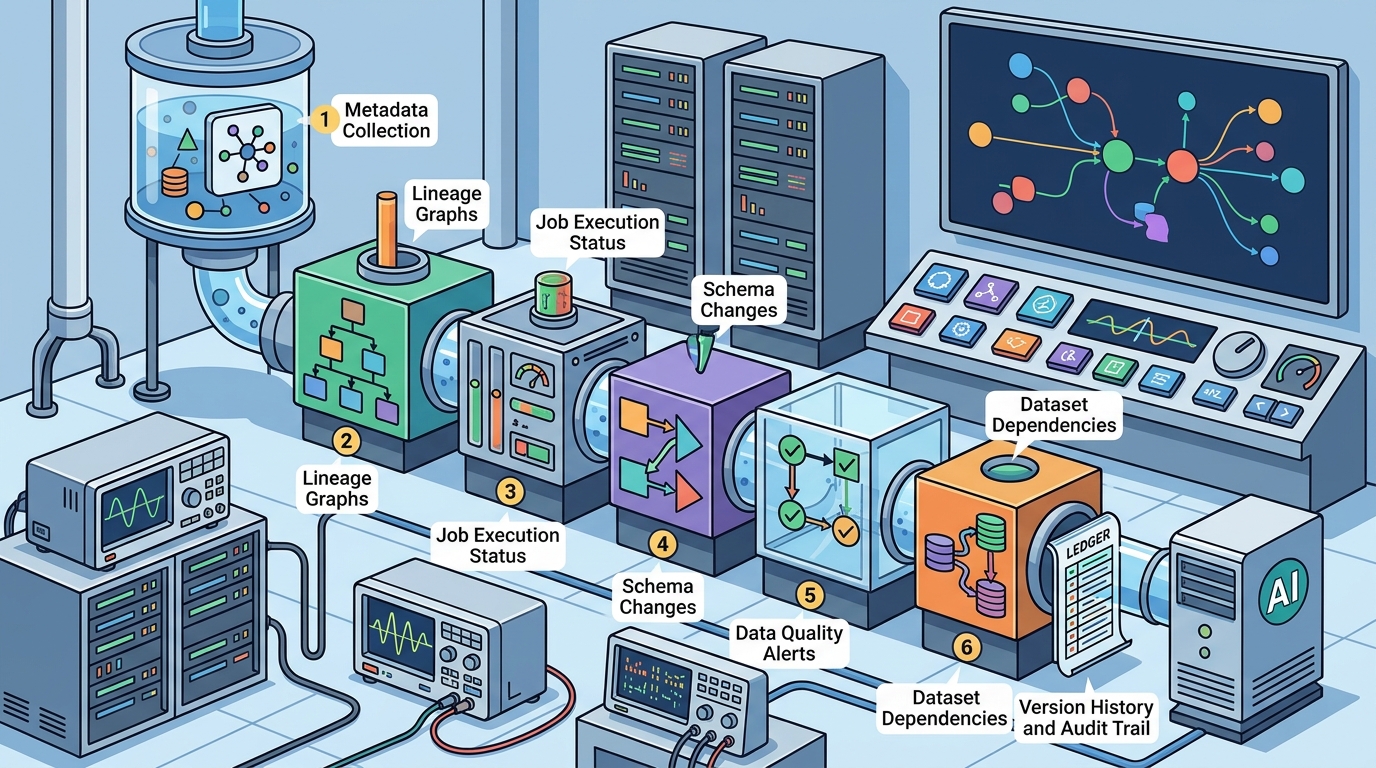
5. Support for Multiple Data Formats
6. Extensibility via Custom Facets
7. Interoperability with Data Catalogs
Seamless connection to metadata stores. OpenLineage events can be consumed by various data catalogs and metadata stores. This interoperability ensures that lineage data is not siloed but is accessible to the entire organization. It facilitates better governance and compliance by providing a single source of truth for data provenance.
Choosing the Right Features
When implementing OpenLineage for AI pipelines, prioritize the Standardized Event Schema and Job/Run Identification first. These form the backbone of any lineage system. Once the core is in place, extend with custom facets to capture AI-specific metrics. This phased approach ensures stability while adding depth to your data governance strategy.
Frequently Asked Questions
What is OpenLineage?
OpenLineage is an open standard for collecting and storing lineage data across data pipelines. It defines a common schema for representing data flow and metadata.
How does OpenLineage help with AI training?
It provides traceability for the data used in model training. This ensures that datasets are verifiable and that any issues in the data can be traced back to their source.
Can OpenLineage be used with custom Python scripts?
Yes, OpenLineage can be integrated with custom scripts. Developers can emit lineage events from their code to track data transformations.
What is a facet in OpenLineage?
A facet is a structured piece of metadata attached to a dataset or job. It allows for the storage of specific attributes like schema or size.
Does OpenLineage require a specific data catalog?
No, OpenLineage is agnostic to the data catalog. It produces standard events that can be consumed by various metadata stores.