

Why AI Teams Prefer Restricted Sandbox Datasets Over Open Simulation Data
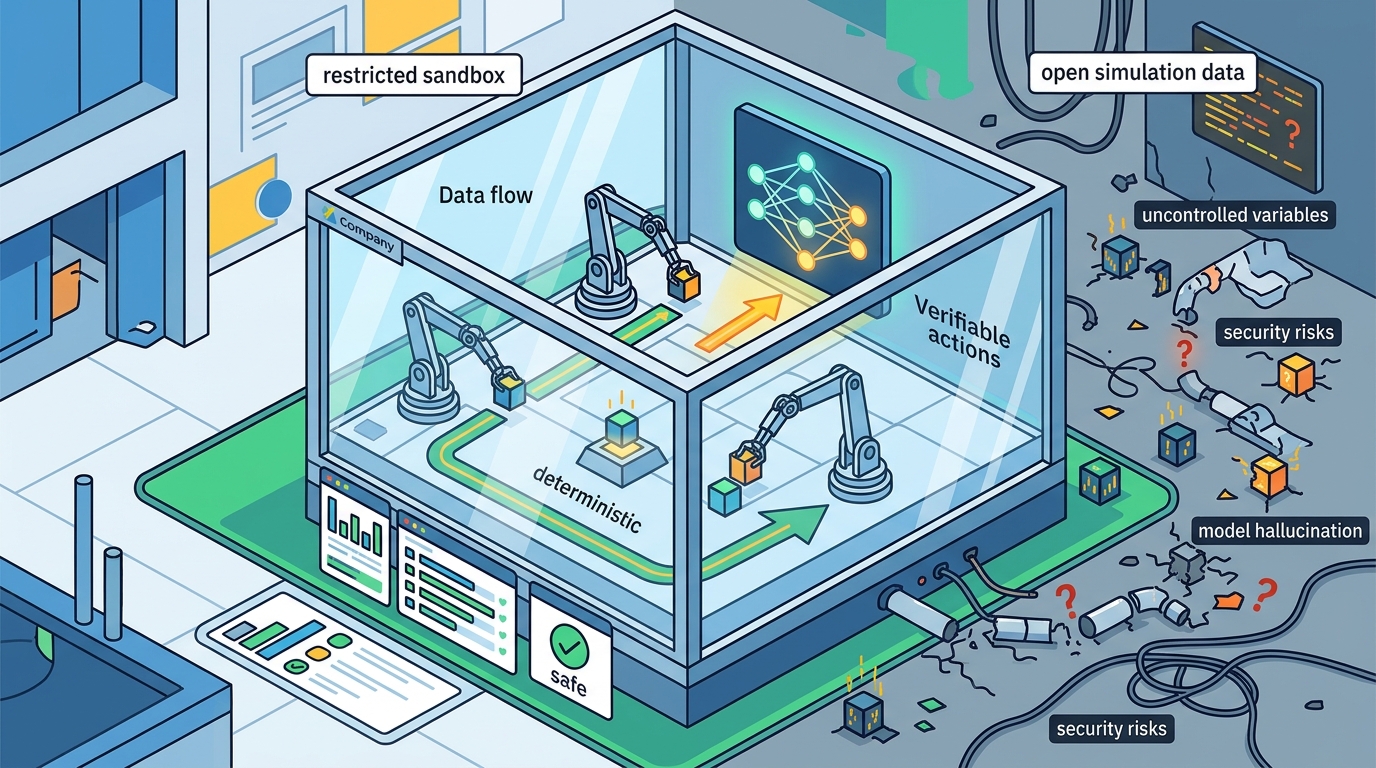
AI teams choose restricted sandbox datasets because they provide deterministic, verifiable, and safe training environments. Open simulation data often introduces uncontrolled variables and security risks that compromise model reliability. By isolating agents in controlled environments, developers ensure that every action and outcome is traceable and reproducible. This approach minimizes hallucination risks and strengthens the evidence base for model validation. For additional details, review the Corey Jacobs QA Engineer.
The Security Imperative in Agent Training
Security is the primary driver for adopting restricted environments. When agents interact with open systems, they can inadvertently access sensitive data or execute harmful commands. A restricted sandbox limits the agent's scope of action to a specific, owned environment. This isolation prevents data leakage and ensures that training interactions do not impact production systems. For example, a financial trading agent trained in a sandbox cannot accidentally execute real trades during validation. This boundary is critical for compliance and risk management. For additional details, review the Frequently Asked Questions.
Determinism and Reproducibility in Model Evaluation
Reproducibility is a cornerstone of scientific rigor in machine learning. Open simulations often rely on stochastic processes that produce different results on every run. This variability makes it difficult to isolate the cause of model failures. In a restricted sandbox, the environment state is fixed and known. Developers can run the same scenario multiple times to verify consistent behavior. This determinism allows teams to pinpoint specific flaws in the agent's decision-making logic. It transforms evaluation from a guessing game into a precise diagnostic tool. For additional details, review the About.
Evidence-Bound Claims and Source Lineage
Managing Uncertainty in Controlled Settings
Uncertainty is an inherent part of AI decision-making. In open environments, uncertainty is often ambiguous and hard to quantify. Restricted sandboxes allow developers to explicitly model and measure uncertainty. By controlling the variables, teams can determine how much confidence an agent has in its predictions. This explicit uncertainty metric helps in setting appropriate thresholds for action. It prevents agents from acting on low-confidence guesses in high-stakes scenarios. This control is vital for safety-critical applications like autonomous driving or medical diagnostics.
Key Takeaways
- Restricted sandboxes enhance security by isolating agents from production systems.
- Deterministic environments enable precise and reproducible model evaluation.
- Controlled settings allow for explicit quantification of model uncertainty.
- Open simulation data introduces uncontrolled variables that complicate debugging.
- Restricted environments are essential for compliance in regulated industries.
Frequently Asked Questions
What is a restricted sandbox environment in AI training?
A restricted sandbox environment is an isolated, controlled space where AI agents operate without access to external systems or sensitive data.
Why is reproducibility important for AI model evaluation?
Reproducibility is important because it allows developers to verify that model behavior is consistent and to isolate the root causes of errors.
How does source lineage improve AI transparency?
Source lineage improves transparency by providing a complete record of the data and actions that led to a specific model output.
Can open simulation data be used for safety-critical AI?
Open simulation data is generally less suitable for safety-critical AI because it lacks the control and determinism needed for rigorous safety validation.
What role does uncertainty play in restricted sandbox datasets?
Uncertainty plays a critical role by allowing developers to explicitly measure and manage the confidence levels of agent decisions in a controlled setting.