

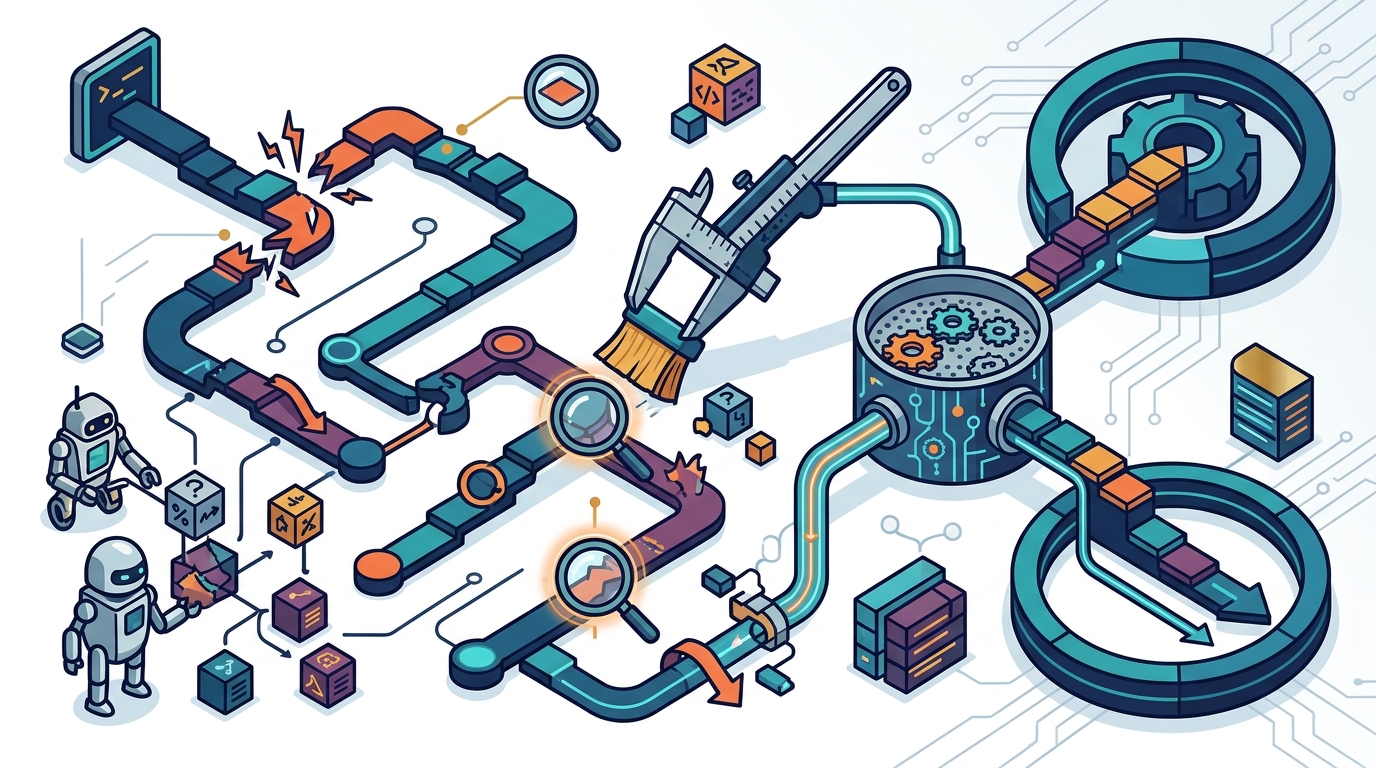
Agent failure trajectories are complete execution logs that capture every step an AI agent takes, including errors, dead ends, and unexpected outcomes. These records provide the raw material needed to diagnose why models fail in complex environments. By analyzing these traces, developers can identify specific weaknesses in planning, memory, and action execution. Gold Trace Dataworks curates these datasets to ensure that failed runs remain visible and traceable, preventing the smoothing of errors into misleading success metrics.
1. Diagnosing Compounding Errors in Long Sessions
Failure trajectories reveal how small mistakes accumulate over time. Reliability is not a static property; it degrades as errors compound across extended sessions. Research indicates that modeling how reliability evolves over time is a critical next step for AI systems. By examining full trajectories, engineers can pinpoint the exact moment a minor deviation leads to a total system failure. This visibility allows for targeted fixes rather than broad, ineffective retraining.
2. Building Robust Anomaly Detection Models
Labeled failure data enables high-accuracy anomaly detection. Supervised and semi-supervised approaches can achieve high accuracy when trained on curated trajectory data. A recent study benchmarking anomaly detection methods on multi-agent systems showed accuracies up to 98% for supervised models. These models learn to distinguish normal operational patterns from silent failures. This capability is essential for catching errors before they aggregate into business problems.
3. Mapping Systemic Failure Taxonomies
4. Preventing Silent Failures in Multi-Agent Systems
Traceable evidence exposes hidden failures in complex agent interactions. In multi-agent systems, failures can propagate across agents in ways that are invisible to standard monitoring. Silent failures occur when an agent produces an incorrect result without triggering an error state. Curated datasets that preserve the source and transformation of every data point make these hidden issues detectable. This transparency is crucial for maintaining trust in autonomous systems.
5. Optimizing for Reliability Over Raw Capability
Failure analysis shifts the focus from capability to dependability. Current AI development often prioritizes capability metrics, which can mask underlying reliability issues. Optimizing agents directly for reliability dimensions ensures they perform consistently under pressure. This shift is supported by the vision of reliability evaluation becoming a standard component of model releases. It aligns AI development with the rigorous standards of safety-critical domains.
6. Validating Governance Scaffolding
Failure trajectories test the effectiveness of governance controls. Governance scaffolding is the set of rules and checks designed to catch errors before they impact operations. Without proper governance, firms risk canceling projects due to unmanaged failure modes. By analyzing how agents behave under governance constraints, developers can validate that their controls are effective. This ensures that the underlying return on investment is not eroded by uncaught errors.
7. Creating Evidence-Bound Training Datasets
Traceable data ensures every training example has a verifiable origin. An evidence-bound dataset is one where every row retains its source, transformations, and evaluation status. This level of traceability is rare in standard AI training materials. It allows developers to verify the integrity of the data used to train their models. Gold Trace Dataworks specializes in creating these high-fidelity datasets for rigorous model validation.
Choosing the Right Approach
Select the analysis method that matches your specific failure mode. Use anomaly detection for real-time monitoring, taxonomies for root cause analysis, and evidence-bound datasets for long-term model improvement. Each approach addresses a different layer of the reliability stack.
Frequently Asked Questions
What is an agent failure trajectory?
An agent failure trajectory is a complete log of an AI agent's execution, including all steps, errors, and outcomes, even when the final result is a failure.
Why are failed runs important for AI training?
Failed runs provide negative examples that teach models what not to do. They reveal specific weaknesses in planning and execution that success-only data hides.
How does Gold Trace Dataworks handle failed runs?
Gold Trace Dataworks keeps failed runs and unknown outcomes in the record. They are not smoothed into success scores, ensuring the data remains traceable and verifiable.
Can anomaly detection catch silent failures?
Yes, when trained on curated trajectory data, anomaly detection models can identify silent failures with high accuracy. This allows for intervention before errors compound.
What is the difference between capability and reliability?
Capability measures what an AI can do, while reliability measures how consistently it does it. An agent can be highly capable but unreliable if it fails frequently under stress.