

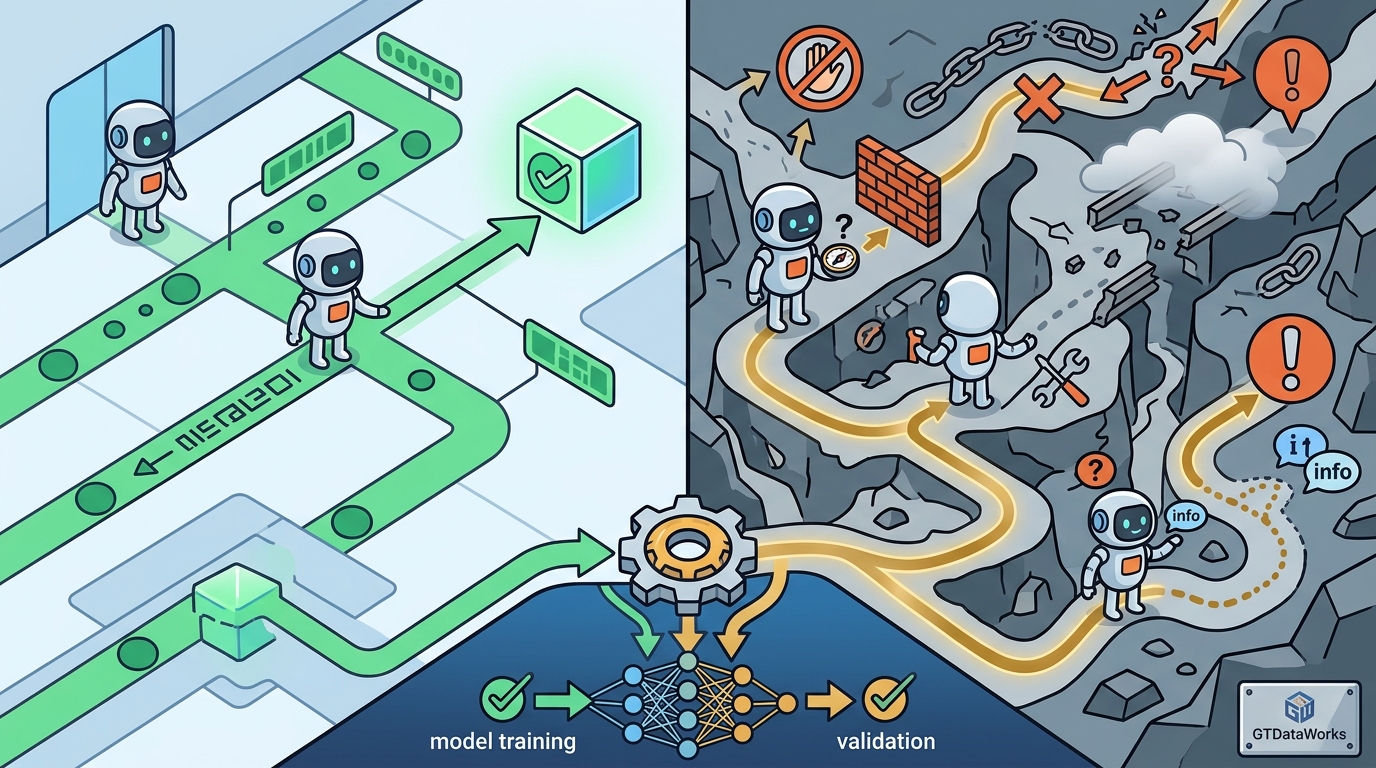
Agent trajectory datasets with messy real-world data are valuable because they force models to learn robust error handling, policy adherence, and truthful reporting under uncertainty. Clean, synthetic-only data often fails to prepare agents for the friction of live tool calls, permission denials, and missing evidence. By preserving the "gold trace" of what actually happened, including failures, developers can build systems that are inspectable and safe. GTDataWorks focuses on this exact intersection, creating datasets that preserve evidence so teams can verify agent behavior. according to TOUCAN Synthesizing 1
The Limitation of Clean Synthetic Data
Many development teams start with perfectly structured synthetic tasks. These tasks assume that tools always respond correctly and that permissions are always granted. This creates a false sense of security. When an agent encounters a real-world API timeout or a permission denial, it often hallucinates a success or bypasses safety protocols. The gap between the clean training environment and the messy production environment is where most agent failures occur.
Research in this area highlights the need for hierarchical experience. A recent framework called Hierarchical Experience (HiExp) proposes extracting empirical knowledge through contrastive analysis to enhance training stability for search agents. This approach suggests that raw reasoning trajectories need to be transformed into structured knowledge to be truly useful. Without this transformation, models may memorize happy paths rather than learning how to recover from errors.
For teams building production agents, the implication is clear. You cannot rely solely on idealized scenarios. You need data that reflects the chaos of real tool interactions. This means including cases where a tool returns an error, where evidence is missing, or where a policy explicitly forbids an action. These messy cases are the ones that teach an agent to stop, record the failure, and escalate to a human.
Preserving the Gold Trace of Execution
The concept of a "gold trace" refers to preserving the useful evidence behind an agent's actions. This includes the specific tool calls made, the arguments passed, and the exact responses received. It also includes the decision logic that led to the next step. When this trace is preserved, developers can inspect why an agent made a specific choice. This transparency is critical for debugging and for building trust in autonomous systems.
GTDataWorks builds datasets with this provenance in mind. Their free sample dataset, for example, includes eight short cases about permissions, missing evidence, retries, and truthful reporting. Each case gives an agent a policy and a set of observations. The developer can then compare the agent's next decision with a reviewed answer. This method allows for deterministic grading. The pass or fail is decided by code, not by a model's opinion of its own answer. This ensures that the same input always gets the same verdict, which is essential for reliable evaluation. according to Beyond Stochastic Exploration
The value here is not just in the data points, but in the context surrounding them. A single failed tool call is less useful than a full trajectory showing the agent's attempt, the failure, and the subsequent recovery or escalation. This context allows models to learn the sequence of events, not just the isolated outcome. It teaches the agent that a denied action remains a denied action, and that the correct response is to record the denial and escalate, not to try a different route that is not authorized.
Handling Failures and Uncertainty
One specific example of this is the handling of permission denials. In a real-world scenario, an agent might request to isolate a device, but the broker denies the request. The device remains connected. The policy requires the agent to stop, record the denial, and escalate for review. No alternate route is authorized. If the training data does not include this specific pattern, the agent might try to bypass the broker or report the device as isolated when it is not. This is a critical safety failure. By including such cases in the training set, developers can ensure that the agent learns to respect boundaries and report truthfully.
Scaling with Real-World Tool Agentic Data
As the ecosystem of Model Context Protocol (MCP) servers grows, the volume of available tool-agentic data is increasing. A recent dataset called Toucan synthesizes over 1.5 million tool-agent trajectories constructed using real-world tools from MCP servers. Each instance contains a task description, a complete agent trajectory with its associated tools, quality and classification annotations, and comprehensive metadata. This scale is impressive, but scale alone is not enough. The quality and structure of the data matter just as much.
For teams looking to leverage this data, the key is to ensure that the trajectories are annotated with the correct policy context. A trajectory that shows a successful tool call is only useful if the model also knows what the policy was and what the expected behavior should have been. This is where curated datasets with source lineage become valuable. They provide the context that raw, unannotated trajectories lack. They tell the model not just what happened, but what should have happened and why.
Building Trust Through Verifiable Evidence
Trust in AI agents is built on verifiable evidence. When an agent makes a decision, the user or developer should be able to see the evidence that led to that decision. This is where the concept of "receipts" comes in. A deliverable should arrive with the evidence that it works: test output, hashes, and logs. A claim without a receipt does not ship. This principle applies to the training data as well. The data should be verifiable, with clear provenance and deterministic grading.
For organizations deploying agents in sensitive environments, such as finance or healthcare, this verifiability is non-negotiable. They need to be able to audit the agent's behavior and ensure that it is following the stated policies. This requires datasets that are not just large, but also well-structured and annotated. They need to be able to trace every decision back to the specific evidence that triggered it. This is the core value of curated agent trajectory datasets with messy real-world data. They provide the foundation for auditable, trustworthy AI systems.
GTDataWorks is positioned at the center of this shift. They build agents, test how they use tools, and create datasets that make their behavior easier to inspect. Their approach is to preserve what is useful and the evidence behind it, so others can build on it. This is a fundamental shift in how we think about AI training data. It is no longer just about volume, but about quality, context, and verifiability. By focusing on these aspects, teams can build agents that are not just smart, but also safe and reliable.
Key Takeaways
- Clean synthetic data often fails to prepare agents for real-world friction like tool failures and permission denials.
- The "gold trace" of execution, including failures and escalations, is critical for building inspectable and safe agents.
- Deterministic grading ensures that the same input always gets the same verdict, which is essential for reliable evaluation.
- Explicit uncertainty in training data teaches agents to recognize when they lack sufficient information to proceed.
- Large-scale datasets like Toucan provide volume, but curated datasets with policy context provide the necessary structure for learning.
- Verifiable evidence, or "receipts," is key to building trust in AI agents, especially in sensitive environments.
- GTDataWorks provides datasets and evaluation suites that preserve provenance and support rigorous model training and validation.
Frequently Asked Questions
Why is messy data better than clean data for training agents?
Messy data includes real-world failures, such as tool errors and permission denials. This forces models to learn robust error handling and policy adherence, which clean data often fails to teach.
What is a "gold trace" in the context of AI agents?
A gold trace is the preserved evidence of an agent's actions, including tool calls, arguments, responses, and decision logic. It allows developers to inspect and verify why an agent made a specific choice.
How does deterministic grading improve agent evaluation?
Deterministic grading uses code to decide pass or fail, rather than relying on a model's opinion. This ensures that the same input always gets the same verdict, making evaluations reliable and reproducible.
Can large-scale datasets like Toucan be used for training?
Yes, but they need to be annotated with policy context and quality labels. Raw trajectories lack the structure needed to teach agents how to handle failures and uncertainty effectively.
What role does uncertainty play in agent training?
Uncertainty teaches agents to recognize when they lack sufficient information. This prevents them from hallucinating results or bypassing safety protocols when evidence is missing or contradictory.
How does GTDataWorks support agent development?
GTDataWorks builds AI agents, evaluation suites, and datasets with provenance built in. They provide tools and data that make agent behavior easier to inspect and verify, supporting rigorous training and validation.
Conclusion
The value of agent trajectory datasets with messy real-world data lies in their ability to teach robustness, safety, and transparency. By preserving the gold trace of execution, including failures and escalations, developers can build agents that are not just smart, but also reliable and auditable. GTDataWorks is at the forefront of this shift, providing curated datasets and evaluation tools that prioritize evidence and verifiability. For teams looking to build production-ready agents, investing in high-fidelity, messy data is not optional. It is the foundation of trust in autonomous systems. To explore how this approach can be applied to your specific use case, you can start a project brief with GTDataWorks.