

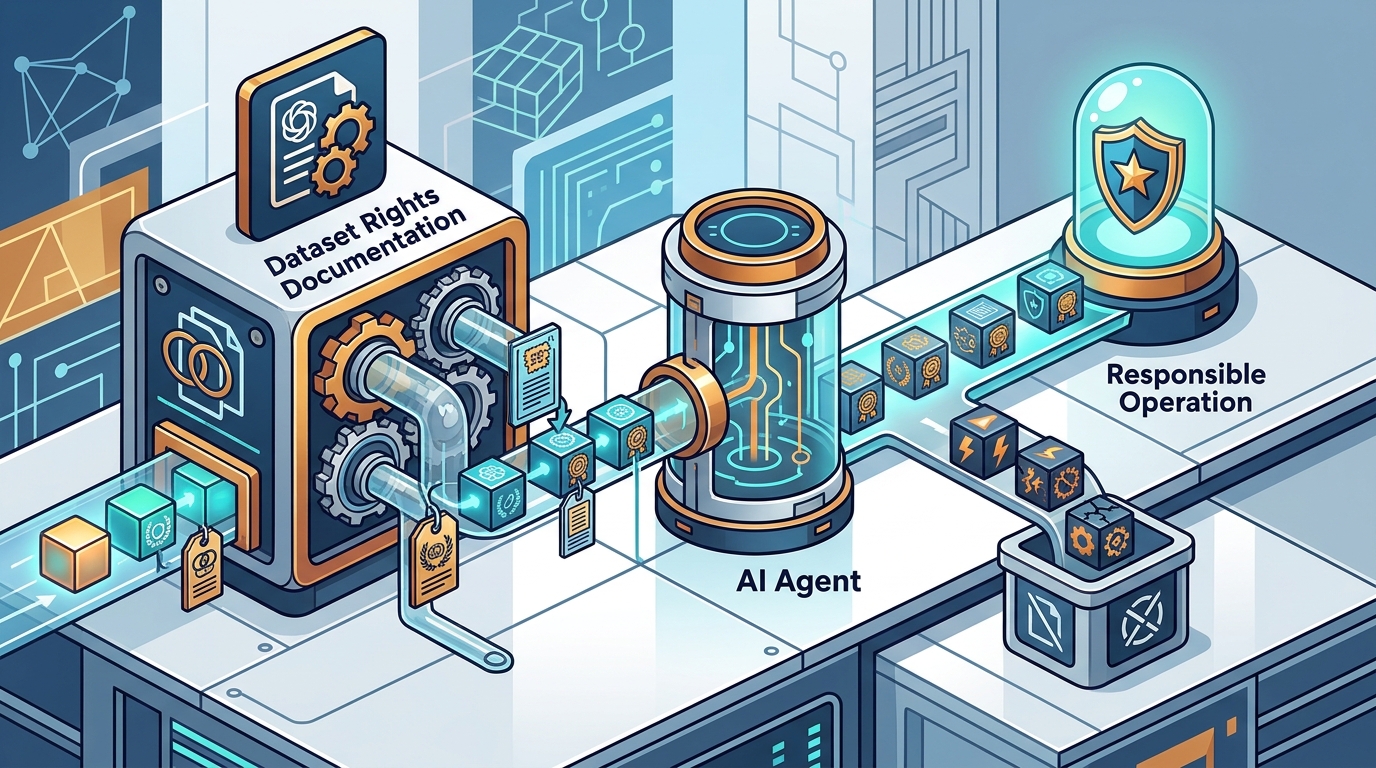
Documenting dataset rights involves recording the legal status, licensing terms, and provenance of every data point used in model training. This practice ensures that AI agents operate within legal boundaries and maintain ethical integrity. Gold Trace Dataworks emphasizes that every row in a curated dataset must retain its source, transformations, and rights status. This approach prevents the smoothing of failed runs or unknown outcomes into false success metrics. according to Data Governance Challenges
The Legal Necessity of Rights Documentation
Regulatory frameworks are increasingly demanding explicit proof of data rights. The EU AI Act, for instance, requires providers of general-purpose AI models to implement policies complying with Union law on copyright. Research on AI data transparency notes that while no explicit transparency requirement exists for all data, compliance often requires confirming that copyright filtering was performed. Without this documentation, organizations cannot demonstrate that their training sets were governed rather than improvised. For additional details, review the Customer Experience.
Provenance and Lineage Tracking
Data lineage is the monitoring of changes in datasets due to new data collection or the removal of harmful samples. Ethical AI practices suggest that tracking this lineage is essential for identifying biases and ensuring fairness. When a dataset evolves, the rights status of individual components may change. A document that was public domain at collection time might later be subject to new licensing restrictions. For additional details, review the Frequently Asked Questions.
Technical tools such as content-based identification and fingerprinting can improve data provenance. Generative AI copyright research encourages the refinement of these methods to standardize transparency. By attaching a manifest hash to each data entry, developers can verify that the training data has not been altered in ways that violate its original license. This level of detail is often missing in standard machine learning pipelines.
Separating Rights from Quality Metrics
Conflating data quality with data rights is a common error. A dataset may be high-quality in terms of accuracy and completeness but still violate copyright laws. Best practices in AI documentation illustrate this with the case of BookCorpus, where researchers found duplications and potential copyright violations. The dataset was previously undocumented, leading to significant legal and ethical implications for models trained on it.
Implementing a Rights Documentation Workflow
Organizations should prioritize dataset approval, legal basis, and purpose checks ahead of model training. Privacy law considerations suggest that these checks should not be an afterthought. Automated discovery and classification can help, but only if the results are tied to stewardship decisions. A passive report is insufficient; the documentation must actively guide the training process.
Retaining evidence that a dataset was reviewed for quality issues relevant to the system's intended purpose is crucial. This is where security and compliance converge. If lineage or access control is weak, you cannot reliably show that the training set was governed. EU AI Act obligations require that this evidence be retained and accessible for audit purposes.
Key Takeaways
- Dataset rights documentation must record legal status, licensing, and provenance for every data point.
- The EU AI Act requires providers to implement policies complying with copyright laws.
- Data lineage tracking helps monitor changes in datasets and identify potential rights violations.
- Separating rights status from quality metrics prevents legal deficiencies from being masked by high-quality scores.
- Automated classification tools must be tied to active stewardship decisions to be effective.
- Pre-training checks for legal basis and purpose are essential for compliance.
- Transparency in data provenance is a growing standard in responsible AI development.
Frequently Asked Questions
What is dataset rights documentation?
Dataset rights documentation is the process of recording the legal status, licensing terms, and provenance of data used in AI training.
Why is provenance important for AI agents?
Provenance is important because it allows developers to verify that data has not been altered in ways that violate its original license.
How does the EU AI Act affect dataset documentation?
The EU AI Act requires providers to implement policies complying with Union law on copyright and related rights.
Can quality metrics replace rights documentation?
No, quality metrics cannot replace rights documentation because a dataset can be high-quality but still violate copyright laws.
What tools can help with data lineage tracking?
Tools such as content-based identification and fingerprinting can help improve data provenance and documentation.
Should rights checks happen before or after model training?
Rights checks should happen before model training to ensure that the dataset is legally compliant and ethically sound.
Conclusion
Responsible AI development requires rigorous documentation of dataset rights. By separating rights status from quality metrics and tracking data lineage, organizations can ensure that their AI agents operate within legal and ethical boundaries. Gold Trace Dataworks provides the tools and frameworks necessary to achieve this level of transparency. Explore their curated datasets to see how evidence-bound claims can transform your AI development process.