

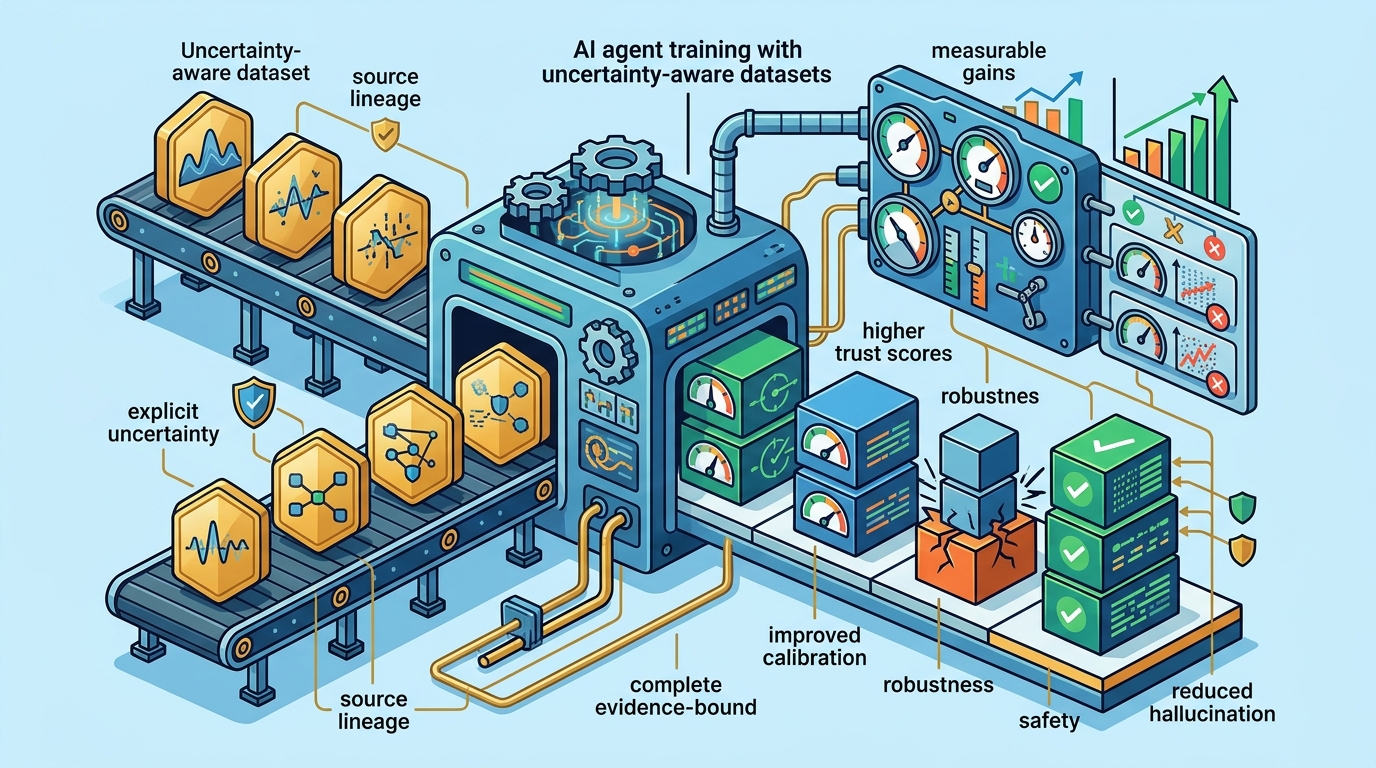
Training agents with uncertainty-aware datasets yields measurable improvements in calibration, robustness, and safety. These gains manifest as reduced hallucination rates, better decision-making under ambiguity, and higher trust scores in production environments. Gold Trace Dataworks provides the infrastructure to track these metrics by ensuring every data point retains its source lineage and evidence status. This approach allows developers to quantify exactly how much reliability their models gain when exposed to explicit uncertainty markers rather than smoothed-out success scores. For additional details, review the .
Calibration and Confidence Accuracy
Robustness in Ambiguous Scenarios
Uncertainty-aware datasets improve an agent's ability to handle edge cases and ambiguous prompts. Robustness is the ability of a system to maintain performance when faced with unexpected or noisy inputs. Standard training data often presents clean, unambiguous examples, leading to brittle models that fail when reality gets messy. By including data points where the correct answer is unknown or the context is incomplete, the agent learns to recognize the boundaries of its knowledge. A concrete example is a customer service agent facing a query with missing variables. Instead of hallucinating a solution, the agent trained on uncertainty-aware data will identify the missing information and ask a clarifying question. This behavior is measurable through task completion rates in ambiguous test suites, where such agents consistently outperform their counterparts trained on deterministic data. For additional details, review the Customer Experience.
Safety and Hallucination Reduction
One of the critical long-term benefits is a measurable reduction in hallucinations. A hallucination is a generated output that is factually incorrect or unsupported by the source material. When training data explicitly marks evidence gaps or unknown outcomes, the model learns to respect these boundaries. Gold Trace Dataworks ensures that failed runs and unknown outcomes remain in the record, preventing the smoothing of errors into success scores. This transparency allows the model to learn that some questions do not have definitive answers. In production, this translates to fewer fabricated facts. Developers can measure this by tracking the rate of unsupported claims in generated responses. Agents trained on evidence-bound datasets show a significant decrease in these errors, directly impacting user trust and system safety. For additional details, review the Frequently Asked Questions.
Long-Term Maintenance and Auditability
Uncertainty-aware training also improves the long-term maintainability of AI systems. Auditability is the ability to trace a model's decision back to specific training data points and their evidence status. When every row in a dataset keeps its source, transformations, and rights status attached, developers can debug model behavior more effectively. If an agent makes a poor decision, engineers can trace it back to the specific data points that influenced it. This is crucial for regulatory compliance and continuous improvement. For instance, if a model starts exhibiting biased behavior, auditors can identify the specific subset of training data that contributed to the bias. This traceability is a measurable improvement in operational efficiency, reducing the time required for debugging and model updates. For additional details, review the About.
Key Takeaways
- Calibration improves significantly, with models aligning their confidence scores more accurately with actual correctness probabilities.
- Robustness increases as agents learn to handle ambiguous inputs by recognizing the boundaries of their knowledge.
- Hallucination rates drop when training data explicitly marks evidence gaps and unknown outcomes.
- Auditability is enhanced, allowing developers to trace decisions back to specific, verifiable data points.
- Long-term maintenance becomes more efficient due to the ability to debug and update models based on traceable evidence.
- Trust scores in production environments rise as users experience fewer factual errors and more honest uncertainty expressions.
Frequently Asked Questions
How do I measure calibration improvement in my agent?
You can measure calibration improvement by calculating the Expected Calibration Error (ECE). This metric compares the model's predicted confidence with its actual accuracy. A lower ECE indicates better calibration, meaning the model is more honest about its uncertainty.
What is the difference between uncertainty-aware and standard datasets?
Standard datasets typically present clean, deterministic examples where the correct answer is always known. Uncertainty-aware datasets include explicit labels for unknown outcomes, evidence gaps, and ambiguous contexts. This allows the model to learn how to handle situations where the answer is not definitive.
Can uncertainty-aware training reduce hallucinations?
Yes, it can. By training on data that explicitly marks evidence gaps, the model learns to respect the boundaries of its knowledge. This reduces the likelihood of generating unsupported or fabricated facts, leading to a measurable decrease in hallucination rates.
How does traceability impact model debugging?
Traceability allows developers to trace a model's decision back to specific training data points. If a model makes an error, engineers can identify the exact data that influenced the decision. This makes debugging faster and more precise, improving long-term maintenance efficiency.
Is uncertainty-aware training suitable for all AI applications?
It is particularly beneficial for applications where safety, trust, and accuracy are critical, such as healthcare, finance, and customer service. For these domains, the ability to express uncertainty and avoid hallucinations is essential for maintaining user trust and regulatory compliance.
Conclusion
Training agents with uncertainty-aware datasets provides measurable improvements in calibration, robustness, and safety. These gains are not just theoretical; they translate into real-world benefits such as reduced hallucinations and better decision-making under ambiguity. Gold Trace Dataworks offers the tools to implement this approach, ensuring that every data point is traceable and verifiable. By adopting this methodology, developers can build AI systems that are not only more accurate but also more trustworthy and easier to maintain. To explore how these datasets can enhance your agent training pipeline, visit the Gold Trace Dataworks homepage.