

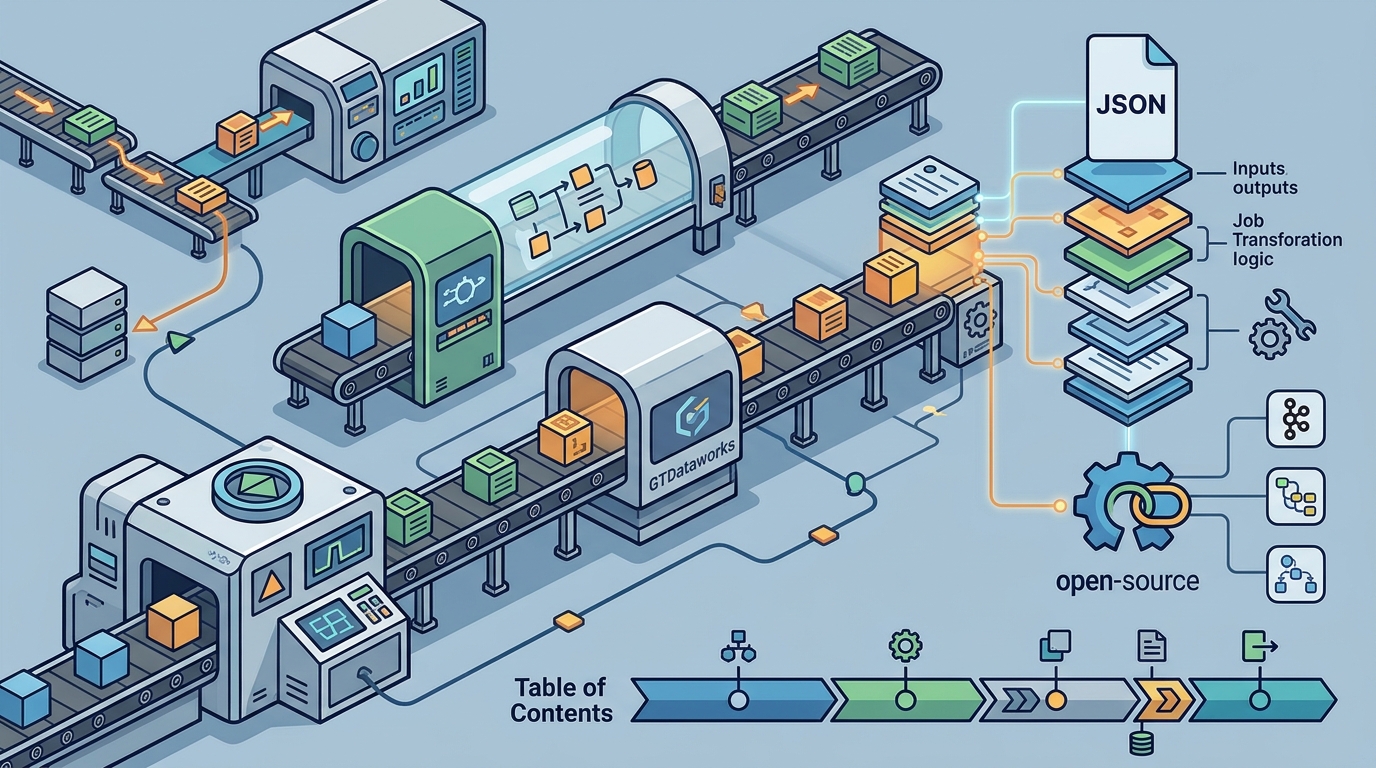
The OpenLineage JSON schema is a standardized format for recording data lineage events, capturing inputs, outputs, and job metadata in a machine-readable structure. It allows systems to track how data moves and transforms across pipelines without relying on proprietary formats. This standard ensures that lineage data remains portable and inspectable across different tools and platforms.
The Core Structure of Lineage Events
At its foundation, the OpenLineage schema defines a specific event structure. An event is a JSON object that represents a single execution of a data job. It contains three primary fields: eventType, eventTime, and run. The eventType indicates the state of the job, such as Start, Complete, or Fail. The eventTime provides an ISO 8601 timestamp for when the event occurred. The run object holds unique identifiers for the specific execution instance.
This structure ensures that every data transformation is tied to a specific point in time and a specific run. For example, a Spark job that processes a CSV file into a Parquet file will emit a Start event when it begins and a Complete event when it finishes. The run field links these two events, allowing a consumer to understand the duration and outcome of that specific transformation. This granularity is critical for debugging and auditing data pipelines.
Representing Datasets and Facets
OpenLineage represents data assets as Dataset objects. A dataset is a named entity that has a namespace and a name. The namespace typically identifies the system or location where the data resides, such as a database name or a cloud storage bucket. The name identifies the specific table, file, or topic within that namespace. This two-part identification ensures global uniqueness for data assets.
Job Metadata and Execution Context
The Job object in the schema describes the transformation logic itself. It includes a namespace and a name, similar to datasets. The job namespace usually refers to the pipeline or workflow system, while the job name identifies the specific task. This distinction is important because a single job can produce multiple datasets, and a single dataset can be produced by multiple jobs.
Jobs can also carry facets that describe the execution environment. For example, a facet might record the version of the code that was executed, the configuration parameters used, or the resources consumed. This level of detail helps teams understand exactly how a transformation was performed. If a data quality issue arises, you can look at the job facets to see if a configuration change or a code update might have caused the problem.
Practical Implications for Data Teams
Using a standardized schema like OpenLineage has significant implications for data engineering teams. It reduces the friction of integrating lineage tools with existing pipelines. Instead of writing custom code for each tool, teams can use standard OpenLineage emitters. This standardization also makes it easier to compare lineage data across different systems. A team can see how a dataset produced by a Spark job relates to a dataset consumed by a Python script, even if those scripts run in different environments.
Furthermore, the schema supports the concept of inputs and outputs within an event. An event lists the datasets that were read (inputs) and the datasets that were written (outputs). This creates a directed graph of data flow. By analyzing this graph, teams can identify critical data paths, detect circular dependencies, and understand the impact of changes to upstream data sources. This visibility is essential for maintaining reliable data infrastructure.
Integrating Lineage with Evaluation
At Gold Trace Dataworks, we view lineage as a critical component of AI agent evaluation. When agents interact with data tools, the lineage of those interactions must be traceable. Our approach to Agent Evaluation & Benchmarking relies on deterministic records that preserve the history of tool usage. This aligns with the principles of OpenLineage, where every event is recorded with a receipt. By combining lineage tracking with rigorous evaluation, teams can ensure that their AI systems are not only transparent but also reliable.
For teams building AI agents that manipulate data, understanding the OpenLineage schema is essential. It provides a common language for describing data transformations. Whether you are using Spark, Airflow, or custom Python scripts, the schema offers a consistent way to capture the flow of data. This consistency is what allows for robust auditing and compliance in modern data stacks.
Key Takeaways
- The OpenLineage schema defines a standard JSON structure for lineage events, including eventType, eventTime, and run.
- Datasets are identified by a namespace and name, ensuring global uniqueness across systems.
- Facets allow for the attachment of rich metadata, such as schema details and ownership, to datasets and jobs.
- Jobs describe the transformation logic and can include facets for execution context, such as code version.
- Events link inputs and outputs, creating a directed graph of data flow for impact analysis.
- Standardization reduces integration friction and enables cross-system lineage comparison.
- Traceable lineage is a foundational requirement for evaluating and auditing AI agent behavior.
Frequently Asked Questions
What is the primary purpose of the OpenLineage schema?
The primary purpose of the OpenLineage schema is to provide a standardized, vendor-neutral format for recording data lineage events. It allows different tools and systems to exchange lineage data in a consistent way, ensuring that data flow can be tracked and audited across an entire data stack.
How does OpenLineage handle different data systems?
OpenLineage handles different data systems by using a namespace and name to identify datasets. The namespace typically represents the system or location, such as a database or cloud bucket. This allows the schema to represent data from any source, whether it is a SQL database, a file system, or a message queue, without requiring system-specific extensions.
What are facets in the OpenLineage schema?
Facets are key-value pairs attached to datasets or jobs that provide additional metadata. They allow users to include information such as data schema, ownership, quality metrics, or execution details. Facets make the schema extensible, enabling teams to track rich context without modifying the core structure.
Can OpenLineage track AI agent actions?
Yes, OpenLineage can track AI agent actions by treating the agent's interactions with tools as jobs. The inputs and outputs of these jobs can be recorded as datasets. This allows teams to trace how an agent uses data and tools, providing a transparent record of its behavior for evaluation and auditing purposes.
Is OpenLineage a proprietary standard?
No, OpenLineage is an open standard maintained by the OpenLineage community. It is designed to be vendor-neutral and is supported by many major data engineering tools. This openness ensures that lineage data remains portable and is not locked into a specific vendor's ecosystem.
Conclusion
The OpenLineage JSON schema provides a robust and flexible framework for tracking data transformations. By standardizing how events, datasets, and jobs are recorded, it enables teams to build transparent and auditable data pipelines. For organizations integrating AI agents into their data workflows, this standard is particularly valuable. It ensures that every action taken by an agent is recorded with the necessary context for evaluation. To discuss a project, contact our team. Learn more: Start a project brief.