

Agent execution trajectories are the complete, step-by-step records of an AI agent's interactions with its environment, including tool calls, decisions, and outcomes. They matter because they provide the verifiable evidence needed to train models that can recover from failures and operate reliably in complex workflows. Without these detailed logs, developers cannot distinguish between a model that succeeded by luck and one that followed a robust logical path.
The Anatomy of a Trajectory
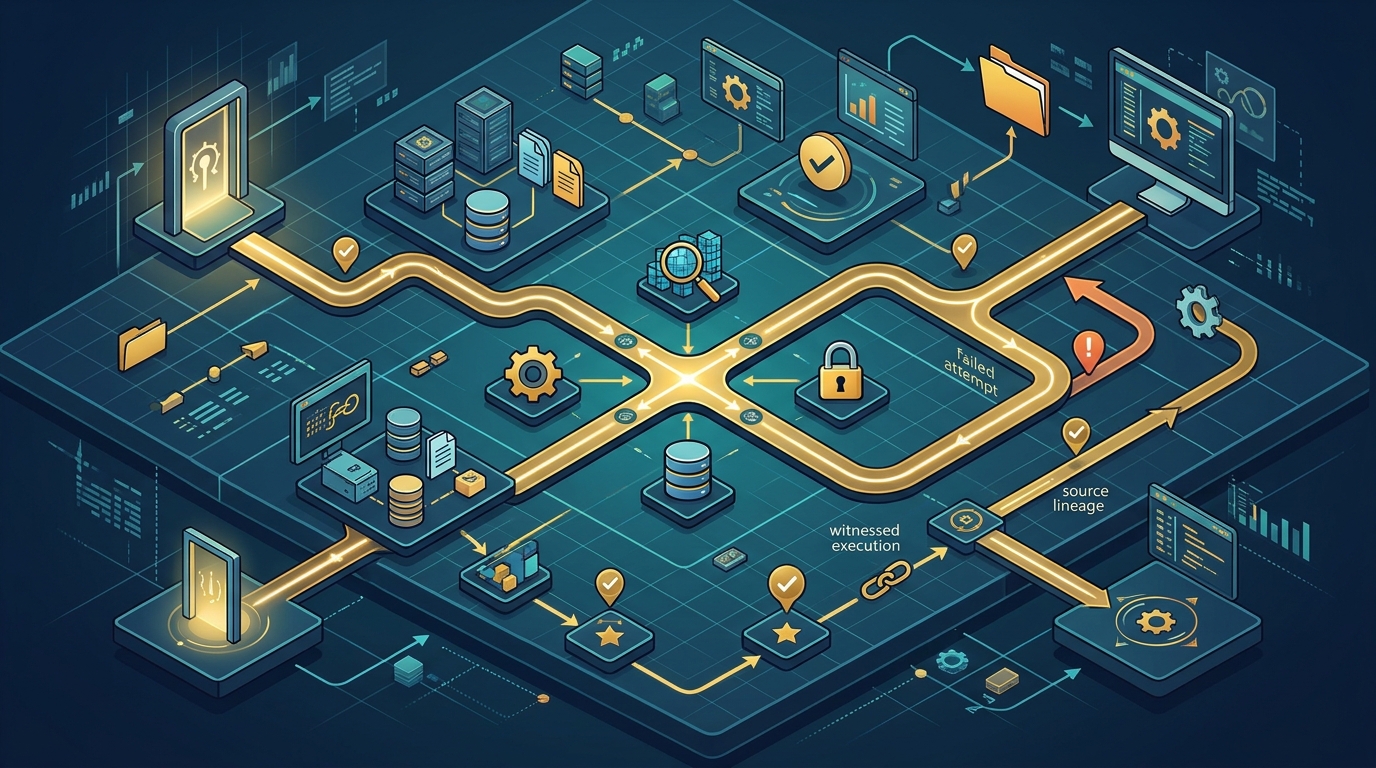
A trajectory is not just a transcript of text; it is a structured sequence of state changes. In a typical run, an agent receives a prompt, selects a tool, executes a function, and processes the result. Each of these steps generates a data point that captures the input, the action taken, and the output received. This granular level of detail allows engineers to inspect exactly where a process diverged from the expected path.
For example, in a workflow involving data retrieval, the trajectory records the specific API endpoint queried, the parameters sent, and the raw JSON response. If the agent then fails to parse that response correctly, the trajectory preserves the error state. This preservation is critical because it turns a single failure into a teachable moment for the model.
Why Failure Data is Essential
Most AI training datasets focus exclusively on successful examples, creating a biased view of how agents should behave. However, real-world environments are full of edge cases, timeouts, and permission errors. An agent that has only seen success is often brittle and unable to handle unexpected disruptions. By including failed attempts in the training data, developers can teach models to recognize error patterns and attempt recovery strategies.
Gold Trace Dataworks emphasizes this approach in its recorded evaluation studies. In a recent evaluation, a subset of scenarios exhausted their retry budget, representing genuine failure states. These records are just as valuable as the successful ones because they define the boundaries of the model's capability. Understanding these limits is essential for building systems that can be trusted in production.
Traceability and Source Lineage
Traceability is the ability to link a final output back to the specific evidence that produced it. In agent systems, this means maintaining a clear lineage from the initial user request to every intermediate tool interaction. Without this lineage, it is impossible to audit why an agent made a specific decision. This lack of transparency is a major barrier to deploying AI in regulated or high-stakes environments.
When a dataset includes source lineage, every data point carries a history of its origin. This allows developers to verify that a model's behavior is grounded in factual inputs rather than hallucinated data. For instance, if an agent generates a report, the lineage shows which documents were read and which calculations were performed. This audit trail is the foundation of trust in autonomous systems.
From Raw Logs to Training Datasets
Raw execution logs are often messy and unstructured, making them difficult to use directly for training. The process of converting these logs into usable datasets involves normalization, privacy checks, and labeling. This transformation step ensures that the data is consistent and safe for model consumption. It also allows for the creation of different views of the same data, such as a full evaluation view and a curated training view.
Gold Trace Dataworks uses a process called refinement to prepare these datasets. The system normalizes records and applies privacy filters while retaining the source links and evaluation results. This ensures that the derived data remains connected to its original evidence. The result is a high-fidelity dataset where every example can be traced back to a witnessed execution, providing a solid foundation for rigorous model training.
Evaluating Agent Performance
Training an agent is only half the battle; the other half is proving that it works. Evaluation involves running the agent against a set of defined scenarios and grading the outcomes using deterministic criteria. This approach removes the subjectivity of human review and provides a repeatable metric for performance. It allows teams to compare different model versions or prompt strategies with confidence.
A robust evaluation system tracks not just the final answer, but the path taken to get there. This means that two agents might produce the same correct answer, but one might have used a more efficient or safer path. By analyzing the trajectories, evaluators can identify which strategies are most reliable. This data-driven approach to evaluation is what separates experimental prototypes from production-ready systems.
Key Takeaways
- Agent execution trajectories are the complete records of an agent's actions, decisions, and outcomes.
- Failure data is as important as success data for training robust and resilient AI agents.
- Source lineage ensures that every data point in a dataset can be traced back to its original evidence.
- Normalizing raw logs into structured datasets is essential for effective model training.
- Deterministic evaluation criteria provide a repeatable and objective measure of agent performance.
- Traceable datasets allow developers to audit and verify the behavior of AI systems in production.
Frequently Asked Questions
What is an agent execution trajectory?
An agent execution trajectory is a chronological record of all actions an AI agent takes during a task, including tool calls, inputs, outputs, and final results. It serves as the primary evidence for evaluating and training the agent.
Why are failed attempts included in training data?
Failed attempts are included to teach agents how to handle errors and edge cases. By learning from failures, models become more robust and capable of recovering from unexpected issues in real-world environments.
What is source lineage in the context of AI datasets?
Source lineage is the metadata that links a data point in a dataset back to the specific source or execution record that generated it. It provides an audit trail that ensures the data is verifiable and trustworthy.
How does Gold Trace Dataworks handle data privacy?
Gold Trace Dataworks applies privacy checks during the data refinement process. This ensures that sensitive information is removed or anonymized before the data is prepared for training, while still retaining the necessary context for evaluation.
Can trajectories be used for both training and evaluation?
Yes, trajectories can be used for both purposes. The same recorded run can be viewed as a training example if it meets certain criteria, or as an evaluation record to measure performance against a rubric. This dual use maximizes the value of the recorded data.
What is the difference between a trajectory and a transcript?
A transcript is typically a text-only record of a conversation, while a trajectory includes structured data about tool interactions, state changes, and system events. Trajectories provide a more complete picture of an agent's behavior than transcripts alone.
Building Trust Through Evidence
As AI agents take on more complex tasks, the need for transparent and verifiable systems becomes critical. Agent execution trajectories provide the evidence base for this transparency. By capturing every step of an agent's journey, developers can build systems that are not only smart but also accountable. Gold Trace Dataworks specializes in turning these raw records into high-fidelity datasets that support rigorous training and evaluation. If you are looking to build AI agents that can be trusted in production, start by focusing on the quality and traceability of your execution data. To plan your visit, contact our team to see how traceable datasets can improve your agent development workflow. Learn more: Start a project brief.